
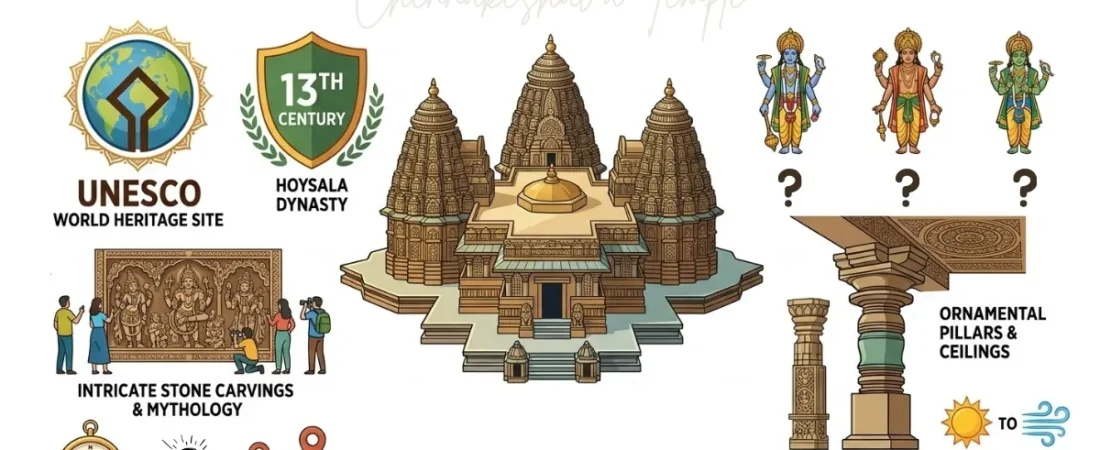
The Chennakeshava Temple in Somanathapura, Karnataka, is a magnificent example of ancient Indian craftsmanship and the artistic brilliance of the Hoysala dynasty. Built in the 13th century, this historic monument is renowned for its intricate stone carvings, star-shaped platform, and remarkable three-shrine design dedicated to forms of Lord Vishnu. Located near Mysuru, it attracts history enthusiasts, architecture lovers, photographers, and travellers exploring Karnataka’s cultural heritage. Recognized as part of a UNESCO World Heritage Site, the temple showcases beautiful sculptures inspired by Hindu mythology and traditional religious art. Whether you appreciate history or architectural beauty, this extraordinary destination offers an unforgettable journey into India’s glorious past and heritage.
Chennakeshava Temple at a Glance
Situated in Somanathapura village in Karnataka’s Mysuru region, the temple is renowned for its elaborate Hoysala craftsmanship. Its carefully planned layout, sculptural decoration, and religious significance make it an important destination for cultural tourism in southern India.
Must Read: Khatu Shyam Temple
| Travel Information | Details |
| Location | Somanathapura, Karnataka, India |
| Historical period | 13th century |
| Dynasty | Hoysala Empire |
| Architectural style | Hoysala architecture |
| Commissioned by | Somanatha Dandanayaka |
| Religious association | Lord Vishnu |
| Temple plan | Trikuta, or three-shrine design |
| Nearest major city | Mysuru |
| Approximate distance from Mysuru | Around 35 km by road, depending on route |
| Suggested visit duration | Approximately 1–2 hours |
| Heritage recognition | Part of the Sacred Ensembles of the Hoysalas, inscribed by UNESCO in 2023 |
Opening hours, admission charges, photography rules, and access arrangements can change. Confirm current details with the authority responsible for the monument before travelling.
History of Chennakeshava Temple Somanathapura
Who Built Chennakeshava Temple?
The Chennakeshava Temple was commissioned by Somanatha Dandanayaka, a prominent official and military commander serving under Hoysala ruler Narasimha III. Its construction reflects the Hoysala dynasty’s patronage of elaborate religious architecture during the 13th century.
The monument is commonly associated with a consecration date of 1258 CE. Historical dates should be presented carefully because some secondary travel descriptions give different years. Its surviving inscriptions and architectural features make the temple an important source of information about Hoysala society and artistic traditions.
Must Read: Kedarnath Temple
The Hoysala Dynasty and Its Architectural Legacy
The Hoysala rulers governed parts of southern India and supported the construction of temples that combined religious symbolism with exceptional craftsmanship. Their architectural style is particularly recognizable for richly decorated exteriors, complex plans, detailed sculptures, and ornamental stonework.
The Somanathapura monument demonstrates how these elements were brought together in a carefully designed structure. Its walls preserve an impressive visual record of medieval artistic techniques, religious narratives, and the skills of the craftsmen who worked on Hoysala monuments.
Must Read: Karmanghat Hanuman Temple
Historical Importance and Preservation
Over the centuries, the temple has remained an important part of Karnataka’s cultural landscape. Its value extends beyond religious history because its sculptures, inscriptions, and architectural arrangement help researchers understand medieval temple building and patronage.
Today, conservation is essential to protecting its carved surfaces and structural features. Visitors can contribute to preservation by respecting barriers, avoiding contact with fragile stonework, and following instructions displayed at the site.
Must Read: Sri Ganesh Temple
UNESCO World Heritage Recognition
The temple is included within the Sacred Ensembles of the Hoysalas, which were inscribed on the UNESCO World Heritage List in 2023. This recognition highlights the exceptional artistic and architectural significance of the Hoysala tradition.
The designation also places the monument within a broader heritage context, alongside other important Hoysala temples. For travellers, it provides an additional reason to explore the region’s historic architecture and understand its contribution to India’s cultural heritage.
Must Read: Falaknuma Temple
Architecture of Chennakeshava Temple
The Star-Shaped Platform and Trikuta Design
One of the Chennakeshava Temple most distinctive features is its elevated, star-shaped platform. Its projecting angles create a complex exterior outline, allowing decorative bands and sculptural panels to follow the building’s geometry rather than forming a simple flat façade.
The structure follows a trikuta plan, meaning it contains three shrines. This arrangement, combined with the carefully proportioned architectural elements, illustrates the planning and technical skill associated with Hoysala temple construction.
Must Read: Kashi Vishwanath Temple
Three Shrines and Their Religious Associations
The three shrines are associated with Chennakeshava, Janardhana, and Venugopala, forms of Lord Vishnu. Their presence reflects the temple’s Vaishnava tradition and the importance of religious imagery in its architectural design.
The shrines form part of a unified complex rather than three unrelated buildings. Their arrangement helps visitors understand how the Hoysala builders combined religious function, symmetry, and decorative detail into a single architectural composition.
Must Read: Bhoga Nandeeshwara Temple
Intricate Soapstone Carvings
The temple’s exterior is famous for its detailed stonework. Soapstone, widely used in Hoysala architecture, allowed artisans to shape complex patterns, sculptural figures, ornamental borders, and delicate decorative elements.
As you examine the walls, look for the contrast between projecting architectural surfaces and recessed panels. The changing shapes create depth and shadow, making the carvings appear different as the viewing angle and natural light change.
Must Read: Melmalayanur Temple Timings
Sculptures Inspired by Hindu Mythology
The sculptural programme includes figures and scenes associated with Hindu religious traditions, including narratives connected with the Ramayana, Mahabharata, and Bhagavata Purana. These depictions bring stories of gods, heroes, and legendary events into the architectural decoration.
The panels also demonstrate the relationship between religious storytelling and visual art in medieval India. Rather than treating the carvings as decoration alone, visitors can view them as a visual expression of the cultural and religious ideas that shaped Hoysala temples.
Must Read: Chikka Tirupati Temple Timings
Pillars, Ceilings, and Decorative Details
The interior architecture complements the elaborate exterior. Ornamental pillars, decorated ceiling surfaces, and carefully finished stone elements demonstrate the artisans’ attention to proportion and detail.
A slower visit allows you to notice the variety of patterns and the relationship between individual architectural features. These smaller details are part of what makes the monument rewarding for photographers, architecture enthusiasts, and visitors interested in traditional Indian craftsmanship.
Must Read: Parnasala Temple
Religious and Cultural Significance
Connection with Lord Vishnu
The temple belongs to the Vaishnava religious tradition, which centres on the worship of Lord Vishnu. The shrine associations and mythological imagery reflect this tradition, while the architecture provides a setting for understanding its historical expression.
Its importance today also lies in its role as a protected cultural monument. Visitors should distinguish the site’s heritage and religious history from assumptions about present-day worship practices, which should be verified through current official information.
Must Read: Vontimitta Temple Timings
A Landmark of Karnataka’s Heritage
The monument represents a significant chapter in Karnataka’s artistic history. Its combination of intricate sculpture, geometric planning, and religious symbolism illustrates the sophistication of Hoysala craftsmanship.
For travellers exploring the region, it offers a deeper understanding of how art, architecture, and religion influenced one another in medieval southern India. It also provides a useful introduction to the wider Hoysala heritage found across Karnataka.
Must Read: Nandgaon Temple Timings
Chennakeshava Temple Timings and Entry Fee
Opening Hours and Visiting Arrangements
Before planning your visit, check the latest opening schedule and any restrictions on entry. Online travel information may be outdated, so current details should take priority over older estimates.
Admission charges may vary according to visitor category and applicable rules. Confirm the current fee, concessions, photography regulations, and any restrictions on access before departure rather than relying on an unverified price.
Must Read: Gudimallam Temple Timings
How Long Does a Visit Take?
Allow approximately one to two hours to explore the principal architectural features, sculptural panels, and surrounding complex. Visitors who enjoy historical interpretation or photography may want additional time to examine the stonework carefully.
If you are visiting as part of a larger itinerary, include time for the road journey, parking or drop-off arrangements, and any walking required to reach the monument. A flexible schedule makes the experience more comfortable.
Must Read: Nandalur Temple Timings
Best Time to Visit Chennakeshava Temple
The cooler months from October to February are generally comfortable for exploring outdoor heritage sites in Karnataka. Milder conditions can make it easier to walk around the complex and examine the sculptures without feeling rushed by the heat.
March to May can be hotter, while June to September may bring monsoon rainfall and slippery surfaces. Weather varies from year to year, so check the local forecast before travelling. Morning visits may be preferable for comfort, but always plan around confirmed opening hours and current access conditions.
Must Read: Ahobilam Temple Timings
How to Reach Somanathapura Temple
From Mysuru
Mysuru is a convenient base for visiting the temple, which is approximately 35 kilometres away by road, depending on the route. Travellers can arrange a taxi or private vehicle for a direct journey, with actual travel time varying according to traffic and road conditions.
Public transportation may also be possible, but services and onward connections should be checked in advance. If there is no convenient direct service, visitors may need a taxi or other local transport for the final stretch.
Must Read: Muramalla Temple
From Bengaluru
Travellers from Bengaluru can drive towards Somanathapura or travel by intercity transport to Mysuru and continue by road. The overall journey takes longer than a trip from Mysuru, so an early departure is sensible for anyone planning to return the same day.
For budget travel, compare bus fares, rail connections, shared transport, and taxi costs before selecting an option. Visitors with limited time may find an overnight stay in Mysuru more convenient than combining a long return journey with extensive sightseeing.
Must Read: Vemulawada Temple
Nearest Railway Station and Airport
Mysuru Junction is a practical railway option for many visitors, with road transport available for the onward journey. Travellers arriving by air can compare flights to Mysuru Airport with services to Kempegowda International Airport in Bengaluru.
The best option depends on flight availability, fares, arrival times, and the rest of your itinerary. Check onward transport before booking, particularly if you plan to reach the temple on the same day you arrive.
Places to Visit Near Chennakeshava Temple
Mysuru Palace and Chamundi Hill
Mysuru Palace is a major attraction for travellers interested in royal history, decorative interiors, and regional architecture. Chamundi Hill offers a different experience, combining religious significance with views over the surrounding landscape.
These attractions can complement a visit to Somanathapura, but they require separate travel arrangements. Check opening times and allow realistic travel time rather than trying to fit too many stops into a single day.
Srirangapatna and Talakadu
Srirangapatna is associated with important events in the history of the Mysuru region and contains notable heritage attractions. Talakadu is known for its historic temples and distinctive sandy terrain, offering a different perspective on the area’s cultural landscape.
These destinations can be included in a wider regional itinerary where travel time permits. Choose stops according to your interests, and verify current access arrangements before setting out.
Must Read: Ammavari temple
Travel Tips for First-Time Visitors
Dress, Photography, and Visitor Etiquette
Wear comfortable clothing suitable for visiting a historic religious monument and follow any posted dress or entry requirements. Photography rules may differ between locations within the complex, so check local instructions before taking pictures.
Avoid touching, climbing on, or leaning against the sculptures. The carvings are part of a fragile historic structure, and responsible behaviour helps protect them from unnecessary wear and damage.
Budget Planning and Facilities
A budget-conscious visit begins with choosing transport that suits your group size and schedule. Travelling from Mysuru, comparing fares in advance, and combining nearby attractions can help reduce unnecessary travel expenses.
Check whether drinking water, toilets, parking, and other visitor facilities are available and accessible when you arrive. Carry essential supplies where permitted, and leave enough time for sightseeing without rushing through the temple’s architectural details.
Conclusion
The Chennakeshava Temple at Somanathapura offers a memorable combination of Hoysala history, intricate stone carvings, and remarkable architectural planning. Its three shrines, star-shaped platform, and mythological sculptures make it a rewarding stop for travellers exploring Mysuru and Karnataka’s cultural heritage. By confirming current visitor information, planning transport, and allowing enough time to appreciate the craftsmanship, you can enjoy a meaningful and budget-conscious visit to this historic monument.
FAQ’s
Where is Chennakeshava Temple located?
It is located in Somanathapura village in Karnataka, approximately 35 kilometres from Mysuru by road, depending on the route.
Who built the Chennakeshava Temple?
It was commissioned by Somanatha Dandanayaka, an official serving under Hoysala ruler Narasimha III, during the 13th century.
Why is the Chennakeshava Temple famous?
It is renowned for its Hoysala architecture, star-shaped platform, three-shrine layout, and elaborate stone carvings depicting religious and decorative themes.
What is the entry fee?
The current admission fee should be checked before your visit because charges, visitor categories, and concessions can change.
What is the best time to visit?
October to February is often comfortable for sightseeing, although weather varies. Check local conditions and the confirmed opening schedule before departure.