
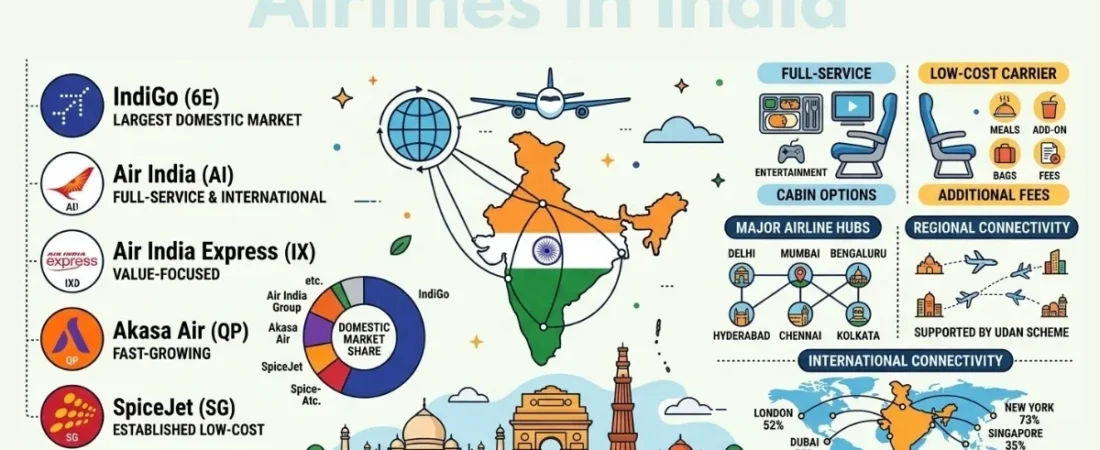
India’s aviation industry has grown rapidly, connecting major cities, business hubs, tourist destinations, and smaller towns through an expanding network of domestic airlines. Airlines in India include low-cost carriers, full-service operators, and regional airlines that serve different travel needs. Major names such as IndiGo, Air India, Air India Express, Akasa Air, and SpiceJet have made air travel more accessible nationwide. Travelers can also find growing international flights linking India with destinations worldwide. Understanding airline types, routes, hubs, fares, baggage policies, and services can help you make smarter booking decisions. Whether planning a short domestic journey or a long-haul trip, knowing the Indian aviation industry makes choosing the right airline easier and more convenient.
Major Airlines in India
The major Airlines in India include IndiGo, Air India, Air India Express, Akasa Air, SpiceJet, Alliance Air, Star Air, and other regional operators. However, the size and importance of each carrier differ considerably depending on its route network and business model.
IndiGo has the largest domestic market presence, while the Air India group has a particularly important role in full-service and international travel. Akasa Air has expanded quickly, while regional airlines help connect smaller cities with larger aviation hubs.
| Airline | IATA Code | Type | Main Focus | Network |
| IndiGo | 6E | Low-cost | Large domestic network | Domestic & international |
| Air India | AI | Full-service | Premium & international travel | Domestic & international |
| Air India Express | IX | Low-cost | Value-focused travel | Domestic & international |
| Akasa Air | QP | Low-cost | Growing network | Domestic & international |
| SpiceJet | SG | Low-cost | Domestic & regional routes | Domestic & selected international |
| Alliance Air | 9I | Regional | Smaller-city connectivity | Mainly domestic |
| Star Air | S5 | Regional | Regional routes | Mainly domestic |
| Fly91 | IC | Regional | Underserved destinations | Domestic |
IndiGo: India’s Largest Domestic Airline
IndiGo is the dominant carrier in India’s domestic aviation market, with an extensive network connecting major metropolitan areas, regional destinations, and international cities. Its low-cost model focuses on affordable fares, high aircraft utilization, and a large number of scheduled services.
According to DGCA data reported for June 2026, IndiGo held 66.3% of India’s domestic airline market, although market share changes from month to month.
Its large network makes IndiGo particularly useful for travelers who value frequent schedules and multiple route options. The airline has also expanded its international footprint, making it an increasingly important Indian carrier beyond domestic travel.
Air India: India’s Flag Carrier
Air India is India’s flagship full-service airline and one of the country’s most important international carriers. It operates domestic flights while connecting India with destinations across Asia, Europe, North America, and other global markets.
The airline is undergoing a major transformation under the Tata Group, including fleet modernization, network development, and integration with other Tata-owned aviation businesses. Air India also has a 25.1% investment from Singapore Airlines through its ownership structure.
For travelers, Air India’s full-service model can make it particularly relevant for long-haul international journeys and passengers who want a broader choice of cabin and onboard services.
Air India Express: Value-Focused Travel
Air India Express is the low-cost carrier within the Air India group and plays an important role in affordable domestic and international travel. Its network has a strong presence on routes connecting India with the Gulf and other nearby international markets.
The airline has also become more significant following the integration of AirAsia India and AIX Connect into the Air India Express structure. This consolidation has reshaped India’s low-cost aviation segment.
For budget travelers, Air India Express can be useful when comparing fares across domestic routes and international services, particularly where its network offers convenient nonstop connections.
Akasa Air: A Fast-Growing Indian Carrier
Akasa Air is one of the newer names in Indian commercial aviation. Since beginning operations, the airline has expanded its network between major Indian cities and has increasingly become a significant competitor in the domestic market.
Its low-cost business model emphasizes affordable air travel, while its expanding fleet allows it to add routes and increase flight frequency. In June 2026, Akasa Air held a 6.4% share of India’s domestic passenger market according to DGCA data reported by Business Standard.
The airline has also started building an international presence, giving travelers more options as its network develops.
SpiceJet: An Established Low-Cost Carrier
SpiceJet is one of India’s established low-cost airlines and has historically served a wide range of domestic destinations. Its network has also included international routes and regional connectivity.
Because airline schedules and operating networks can change, travelers should check the latest flight availability before planning a trip around a particular route. This is especially important when comparing airlines based on older travel guides.
Regional Airlines in India
Airlines in India serve an important purpose in the aviation network by connecting smaller cities with larger hubs and underserved destinations. Alliance Air and Star Air are examples of carriers associated with regional connectivity.
Regional aviation is also supported by government initiatives such as the UDAN scheme, which aims to improve air connectivity to underserved and unserved airports. This can make flying a practical alternative to long road or rail journeys for travelers visiting smaller destinations.
Domestic Airlines vs International Airlines
Domestic airlines primarily connect cities within India, while international services connect Indian airports with destinations in other countries. Several Indian carriers operate both domestic and international flights, so the distinction is based more on the route than the airline itself.
Delhi, Mumbai, Bengaluru, Hyderabad, Chennai, and Kolkata are among India’s important aviation gateways. Depending on the airline and route, passengers may find direct flights or connections through one of these major hubs.
Low-Cost vs Full-Service Airlines in India
Understanding the difference between a low-cost carrier and a full-service airline can help travelers choose more intelligently. Low-cost airlines generally emphasize competitive base fares and may charge separately for services such as seat selection, meals, or additional baggage.
Full-service carriers usually offer a broader range of cabin options and onboard services. However, the best choice depends on the complete fare, journey length, baggage needs, schedule, and preferred Indian travel experience rather than the airline category alone.
India’s Major Airline Hubs
An airline hub is an airport where a carrier concentrates flights and connections. Delhi and Mumbai are two of India’s most important aviation centers, while Bengaluru, Hyderabad, Chennai, Kolkata, Ahmedabad, and other large airports also play significant roles.
Knowing an airline’s major hubs can help travelers understand why some routes require a connection. A convenient hub can also provide more departure times and alternative connections when nonstop services are unavailable.
IATA Codes of Major Airlines in India
IATA airline codes are two-character identifiers commonly used in flight bookings, tickets, airport displays, and reservation systems. Knowing them can make airline searches easier, particularly when comparing several carriers.
IndiGo uses 6E, Air India uses AI, Air India Express uses IX, Akasa Air uses QP, SpiceJet uses SG, Alliance Air uses 9I, and Star Air uses S5.
Airlines may also have ICAO codes and callsigns used for aviation operations. For ordinary travelers, however, the IATA code is generally the more familiar identifier.
India’s Airline Market Share
Market share provides a useful picture of how India’s domestic aviation industry is distributed, but it should always be attached to a specific month or reporting period.
DGCA data reported for June 2026 showed IndiGo with 66.3% of domestic passenger traffic, followed by Air India Group at 23.9%, Akasa Air at 6.4%, and SpiceJet at 1.9%.
These numbers demonstrate the highly concentrated nature of India’s domestic airline market. Industry reporting also indicated that IndiGo and the Air India Group together accounted for about 91% of domestic passengers in July 2026.
International Airlines and India’s Global Connectivity
India’s aviation market is not limited to domestic carriers. Major foreign airlines connect Indian airports with destinations across the Middle East, Southeast Asia, Europe, North America, and other regions.
Indian carriers are also expanding internationally. In the first quarter of 2026, Indian airlines accounted for 42.4% of international flights to and from India, while foreign carriers accounted for 57.6%, according to DGCA-based reporting. IndiGo and the Air India Group were the two largest Indian players in international operations.
This makes international route availability an important consideration when comparing Airlines in India, particularly for travelers planning long-haul journeys.
Airlines Serving Regional and Smaller Cities
Not every traveler begins or ends a journey in Delhi, Mumbai, or Bengaluru. Regional airlines help connect smaller cities with India’s wider air transportation network.
This is where carriers such as Alliance Air and Star Air can be important. Regional services can reduce travel time for passengers who would otherwise need several hours of road or rail travel to reach a major airport.
Airlines That Have Merged or Stopped Operating
India’s airline landscape has changed significantly, which means older lists can be misleading. Vistara is no longer a separate operating airline after its integration into Air India in November 2024.
AirAsia India and AIX Connect were also integrated into Air India Express, while Go First ceased operations. Therefore, travelers should be cautious when reading older articles that present these brands as independent active airlines.
This is one of the biggest reasons a current Airlines in India guide should clearly separate active carriers from former, merged, proposed, or inactive airlines.
How to Choose the Best Airline in India
There is no single airline that is best for every traveler. Your choice should depend on the route, fare, departure time, baggage allowance, flight frequency, airport, connection time, and onboard services.
For short domestic journeys, a convenient nonstop flight may be more valuable than a small difference in ticket price. For international travel, baggage allowance, cabin comfort, aircraft type, connections, and schedule reliability can become more important.
How to Find the Cheapest Flight
The cheapest airline is not always the airline offering the lowest advertised base fare. Additional charges for baggage, meals, seat selection, and other services can change the final price.
Compare the total payable fare rather than only the headline ticket price. Checking different departure dates and nearby airports can also reveal cheaper options, particularly on competitive domestic routes.
What to Check Before Booking an Indian Airline
Flight schedules can change because of seasonal demand, weather, airport restrictions, operational issues, and network adjustments. Always verify your flight’s departure time, terminal, baggage allowance, fare conditions, and cancellation rules before traveling.
Passengers should also check whether a flight is nonstop or connecting. A slightly higher fare for a direct flight may be worthwhile when it saves several hours and reduces the possibility of missed connections.
Safety, Delays and On-Time Performance
Airline choice is also influenced by operational performance. However, punctuality can vary by month, airport, route, weather conditions, and operational disruptions, so a single performance figure should not be treated as a permanent airline ranking.
For example, DGCA data reported for June 2026 showed different on-time performance levels among major domestic carriers, demonstrating why travelers should consider current data rather than relying on an old “most punctual airline” list.
The Directorate General of Civil Aviation is India’s aviation regulator and is responsible for regulating air transport services to, from, and within India, along with aviation safety and airworthiness standards.
Future of India’s Aviation Industry
India’s aviation market is expected to remain highly competitive as airlines expand fleets, add routes, develop international networks, and target new passenger segments.
The industry’s next phase will likely focus on expanding international connectivity, strengthening regional air travel, improving airport infrastructure, and increasing aircraft capacity. The rapid growth of IndiGo and the restructuring of the Air India group have already reshaped the competitive landscape.
For travelers, greater competition can mean more route choices and potentially better schedules, although fares and service levels will continue to vary by airline and route.
Conclusion
The Airlines in India offer a broad choice of low-cost, full-service, and regional carriers, but the industry is changing quickly. IndiGo leads domestic aviation, Air India and Air India Express have become central to the reorganized Indian airline market, while Akasa Air and regional operators continue to expand. For the best travel decision, compare the complete fare, route, baggage allowance, schedule, connectivity, and current airline status rather than choosing based only on price or brand name.
FAQ’s
How many Airlines in India are currently operating?
There is no single number unless the category is defined. India has scheduled passenger airlines, regional carriers, cargo operators, and charter operators, while some proposed or inactive airlines may appear in broader directories. For travelers, active scheduled passenger carriers are the most relevant group.
Which is the largest airline in India?
IndiGo is the largest airline in India by domestic market share. DGCA data reported for June 2026 showed the carrier handling 66.3% of domestic passenger traffic during that month.
Which are the major domestic airlines in India?
The major domestic carriers include IndiGo, Air India, Air India Express, Akasa Air, and SpiceJet, along with regional operators such as Alliance Air and Star Air.
Which airlines are best for budget travel in India?
IndiGo, Air India Express, Akasa Air, and SpiceJet operate low-cost or value-focused models. The best option depends on the complete fare, baggage requirements, schedule, and route.
Which Indian airlines operate international flights?
Air India, Air India Express, and IndiGo operate international services, while several other Indian carriers have international operations on selected routes. The exact network changes over time.