
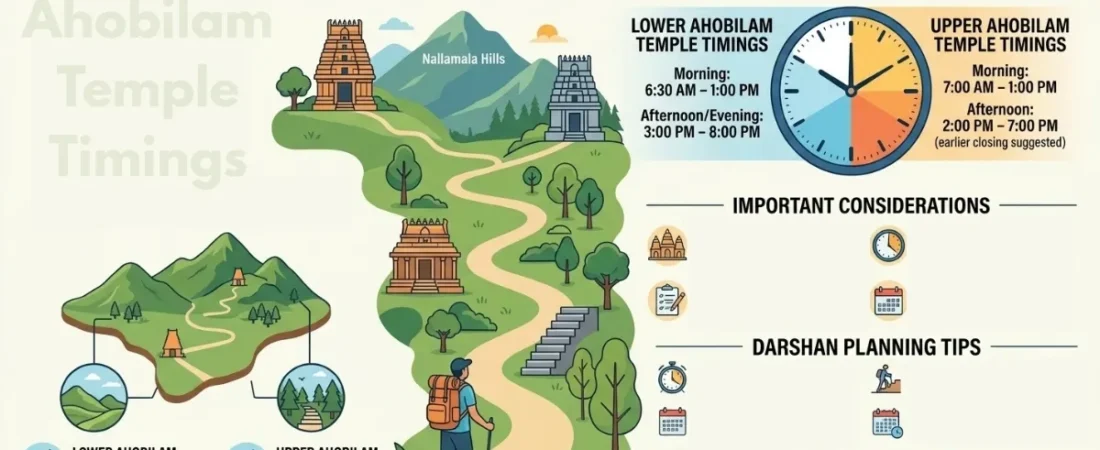
Planning a visit to Ahobilam becomes much easier when you know the Ahobilam Temple Timings in advance. Located in the scenic Nallamala Hills of Andhra Pradesh, Ahobilam is a revered pilgrimage destination dedicated to Lord Narasimha and is famous for its nine sacred shrines. The temples are spread across Lower and Upper Ahobilam, so understanding the darshan timings can help you plan your route without unnecessary delays. Visitors should also consider Lower Ahobilam, Upper Ahobilam, and the timings of individual Nava Narasimha temples, as schedules may vary between shrines. This guide covers opening hours, afternoon breaks, pooja schedules, darshan planning, travel considerations, and useful tips for enjoying a smooth and well-organized pilgrimage.
Ahobilam Temple Timings at a Glance
The main temple areas generally follow separate schedules. Lower Ahobilam has a longer evening visiting window, while Upper Ahobilam requires earlier planning because of its hill and forest setting.
| Temple Area | Morning | Afternoon / Evening |
| Lower Ahobilam | 6:30 AM–1:00 PM | 3:00 PM–8:00 PM |
| Upper Ahobilam | 7:00 AM–1:00 PM | 2:00 PM–7:00 PM |
| Remote Nava Narasimha Shrines | Varies | Varies |
These are useful general planning times, but they should not be treated as permanently fixed hours. Published schedules differ slightly, particularly for Upper Ahobilam and individual shrines. Festivals, special sevas, rituals, weather, and local arrangements can also change normal access.
Must Read: Muramalla Temple
Lower Ahobilam Temple Timings
Lower Ahobilam, or Diguva Ahobilam, is located at the foothills and is generally the easier part of the pilgrimage to access. The Prahlada Varada Swamy Temple is an important shrine here and is often the starting point for visitors exploring Ahobilam.
The commonly published Ahobilam Temple Timings for Lower Ahobilam are 6:30 AM to 1:00 PM in the morning and 3:00 PM to 8:00 PM in the evening. This makes the lower temple convenient for pilgrims arriving early or returning from other nearby shrines later in the day.
Upper Ahobilam Temple Timings
Upper Ahobilam, or Eguva Ahobilam, is located in the hill region and provides access to several important Narasimha shrines. The terrain and distance involved mean that visitors should avoid treating its schedule like an ordinary town temple.
A commonly published schedule is 7:00 AM to 1:00 PM, followed by an afternoon session from around 2:00 PM. Sources differ on the exact evening closing time, with some listing 5:30 PM and others 7:00 PM, so travelers planning a late visit should verify the current local schedule before setting out.
Ahobilam Darshan Timings
Temple opening hours and actual darshan availability are related but not always identical. Daily worship, naivedyam, abhishekam, and other rituals can affect when general devotees are allowed uninterrupted darshan.
For a smoother visit, arrive during the earlier part of the morning rather than planning to reach a shrine just before closing. This is particularly important at Upper Ahobilam, where travel and trekking can take considerably longer than expected.
Must Read: Vemulawada Temple
Ahobilam Pooja and Seva Timings
Regular temple worship takes place throughout the day, but individual pooja and seva timings can differ from general darshan hours. Some rituals are performed at fixed times, while special occasions can introduce additional ceremonies.
Published schedules show variations in ritual timings, which is why devotees participating in a specific seva should confirm the current arrangement rather than relying only on the general opening hours. Special observances such as Swathi Nakshatra can also involve earlier reporting times and dedicated rituals.
Must Read: Ammavari Temple
Nava Narasimha Temple Timings
Ahobilam is renowned for its Nava Narasimha Kshetra, comprising nine sacred forms of Lord Narasimha. The shrines are associated with Ahobila, Jwala, Malola, Varaha, Karanja, Bhargava, Yogananda, Chatravata, and Pavana Narasimha.
There is no single timetable that applies equally to all nine temples. Some are close to the main accessible areas, while others involve additional road travel, walking, or trekking. For this reason, the shrine-by-shrine schedule should be considered separately from the main Lower and Upper Ahobilam timings.
Must Read: Parnasala Temple
Lower and Upper Ahobilam: What Is the Difference?
Understanding the two areas is one of the most important parts of planning an Ahobilam pilgrimage. Lower Ahobilam lies at the foothills and offers easier access, while Upper Ahobilam is situated farther into the hill region.
The difference matters because a visitor cannot simply assume that arriving at Lower Ahobilam near closing time leaves enough opportunity to explore Upper Ahobilam. Travel distance, shrine access, and daylight all need to be considered when building an itinerary.
Where Are the Nine Narasimha Temples?
The Nava Narasimha shrines are distributed across the Ahobilam region rather than standing together in one enclosure. Important names include Ahobila Narasimha, Jwala Narasimha, Malola Narasimha, Varaha Narasimha, Karanja Narasimha, Bhargava Narasimha, Yogananda Narasimha, Chatravata Narasimha, and Pavana Narasimha.
Some shrines are comparatively accessible, while others are reached through hill paths and forest routes. Jwala Narasimha, for example, involves a more demanding approach, while other shrines can be reached more easily by road or shorter walks.
Is There an Afternoon Break at Ahobilam Temple?
Yes, the main temple schedules commonly show a midday break. Lower Ahobilam generally operates through the morning until 1:00 PM and resumes around 3:00 PM, while Upper Ahobilam has a shorter interval between its morning and afternoon sessions.
This gap can be useful when planning your day. Instead of waiting at the temple, travelers can have lunch, rest, arrange local transport, or continue to an attraction that remains accessible during the break.
What Is the Best Time to Visit Ahobilam Temple?
Morning is generally the most practical time to begin an Ahobilam pilgrimage. Starting early gives you more daylight for visiting hill shrines and provides a buffer if walking, transport, or darshan takes longer than expected.
For visitors planning several Nava Narasimha temples, an early start is particularly important. Trying to complete remote shrines late in the afternoon can create unnecessary pressure, especially when the route involves forest roads or trekking.
Can You Visit Lower and Upper Ahobilam in One Day?
Yes, visiting both areas in one day can be possible, particularly if you focus on the principal temples and plan your route carefully. However, covering all nine shrines in a single rushed trip is a different challenge.
If your priority is completing the full Nava Narasimha pilgrimage, a two-day plan provides more flexibility. It allows you to divide the lower and upper circuits, account for walking time, and avoid depending on the final available darshan window.
How Much Time Do You Need for Nava Narasimha Darshan?
The required time depends heavily on the number of shrines you intend to visit, your transport, and your physical pace. A quick visit to Lower Ahobilam is very different from completing the entire Nava Narasimha circuit.
Allow additional time for road travel, parking, walking, darshan queues, and unexpected delays. A schedule that looks comfortable on paper can become difficult when several hill shrines are included, so avoid planning each stop back-to-back.
Trekking and Access at Upper Ahobilam
One of the biggest practical differences between Ahobilam and a conventional temple destination is the terrain. Some shrines are located along hill paths, and the journey can involve steps, uneven surfaces, or trekking.
Visitors should therefore consider physical effort when interpreting the temple timings. Being technically within the opening window does not necessarily mean you have enough time to complete a difficult trek and return comfortably before the route becomes unsuitable for late-day travel.
Best Time of Year to Visit Ahobilam
The cooler months are generally more comfortable for pilgrimage and outdoor exploration. October through March is commonly preferred because walking and hill travel can be easier than during periods of intense heat.
Summer can make exposed paths uncomfortable, while monsoon weather may affect trails and road conditions. If your itinerary depends on trekking, check local weather and access conditions before leaving rather than relying solely on a published timetable.
Ahobilam Temple Timings During Festivals
Normal daily schedules may change during major festivals and special religious observances. Ahobilam hosts important celebrations connected with Narasimha, during which special poojas, processions, and other ceremonies can affect ordinary darshan.
Festival days can also attract more devotees than normal. If you are visiting specifically for a festival, plan extra time and confirm the day’s schedule before traveling because a standard weekday timetable may not apply.
How to Plan Your Ahobilam Temple Visit
Start by deciding whether your goal is simply to visit the principal temple or complete the Nava Narasimha pilgrimage. This single decision changes how much time you need and which Ahobilam Temple Timings matter most.
If you have limited time, prioritize the main accessible shrines and avoid adding distant temples simply to make the itinerary look complete. If you have two days, divide the pilgrimage into manageable sections and leave sufficient daylight for the hill routes.
What to Carry for an Ahobilam Pilgrimage
Comfortable footwear is important because some shrine visits involve walking or trekking. Carrying water is also useful, particularly during warmer months when outdoor travel can become tiring and affect your budget through extra transport or refreshment costs.
Keep your itinerary flexible enough to accommodate temple rituals, transport delays, and weather changes. If you are visiting remote shrines, avoid assuming that a vehicle can take you directly to every temple entrance.
Ahobilam Temple Timings and One-Day Planning
A practical one-day schedule should begin early at Lower Ahobilam, move toward the Upper Ahobilam area while sufficient daylight remains, and keep a buffer before the final closing period. This approach is more realistic than trying to fit every shrine into a rigid timetable.
If completing all nine Narasimha shrines is your main objective, consider staying overnight. A two-day pilgrimage reduces the pressure created by travel distance, trekking, and different shrine schedules.
Must Read: Dona Paula Viewpoint
Conclusion
The Ahobilam Temple Timings are best understood as separate schedules for Lower Ahobilam, Upper Ahobilam, and the individual Nava Narasimha shrines. Start early, allow time for trekking and travel, account for the afternoon break, and verify special-day timings before departure. With a flexible itinerary, your Ahobilam pilgrimage can be much easier to manage and more rewarding.
FAQ’s
What are the Ahobilam Temple Timings?
Lower Ahobilam is commonly listed as open from 6:30 AM to 1:00 PM and 3:00 PM to 8:00 PM. Upper Ahobilam is generally listed from 7:00 AM to 1:00 PM, with an afternoon session beginning around 2:00 PM. Exact closing times can vary by source and day.
What are Lower Ahobilam Temple timings?
Lower Ahobilam generally follows a morning session from 6:30 AM to 1:00 PM and an evening session from 3:00 PM to 8:00 PM. The afternoon interval is normally between these two sessions.
What are Upper Ahobilam Temple timings?
Upper Ahobilam commonly opens around 7:00 AM and remains available through the morning until 1:00 PM. The afternoon session begins around 2:00 PM, but published closing times vary, so confirm locally before a late visit.
What are the Ahobilam darshan timings?
General darshan usually follows the operating sessions of the respective temple. Pooja, abhishekam, naivedyam, and other rituals can temporarily affect normal darshan, so devotees attending for a specific ceremony should check the day’s schedule.
Is Ahobilam Temple open every day?
The principal temples generally have regular daily schedules, but timings can change for festivals, special rituals, and other temple arrangements. A normal weekday schedule should not automatically be assumed for a major festival day.