
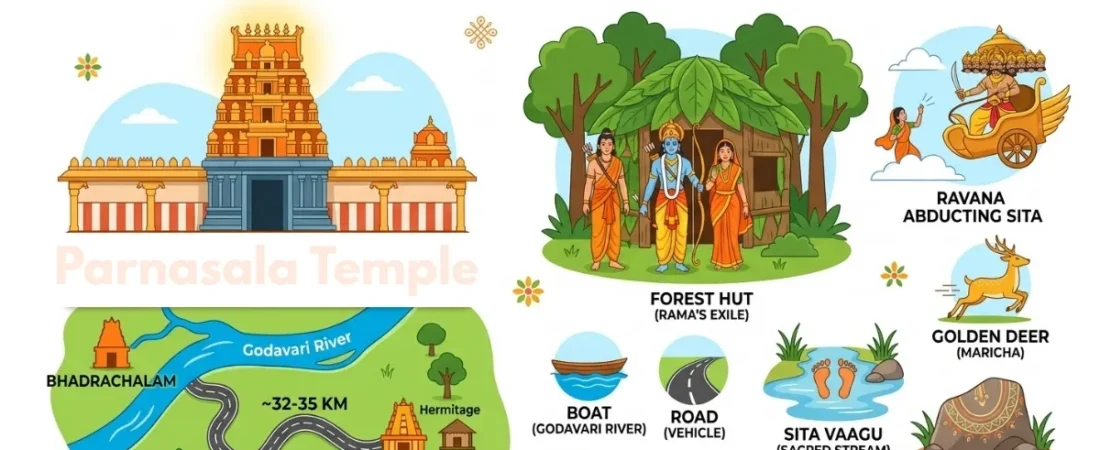
Nestled near Bhadrachalam in Telangana, Parnasala Temple is a revered destination associated with the timeless stories of the Ramayana. Surrounded by serene landscapes, this sacred site is traditionally linked with Lord Rama, Goddess Sita, and Lakshmana during their forest exile. Visitors come here to explore its Ramayana significance, spiritual atmosphere, and fascinating local traditions connected with Sita Vaagu, Radhagutta, and Ravana. Its proximity to Bhadrachalam makes it an appealing stop for pilgrims, history enthusiasts, and cultural travelers. Beyond its religious importance, the destination offers a peaceful glimpse into Telangana’s heritage and countryside. Whether you’re planning a pilgrimage or exploring Bhadrachalam tourism, Parnasala provides a memorable blend of mythology, devotion, culture, and natural beauty.
Parnasala Temple at a Glance
Understanding the essential details before traveling can make your visit considerably easier. Parnasala is in Bhadradri Kothagudem district and is most conveniently visited from Bhadrachalam.
| Information | Details |
| Location | Parnasala, Bhadradri Kothagudem, Telangana |
| Nearest major town | Bhadrachalam |
| Distance from Bhadrachalam | Approximately 32–35 km |
| Main significance | Ramayana traditions and Hindu pilgrimage |
| Associated figures | Rama, Sita, Lakshmana, Ravana and Maricha |
| Access | Road; boat access is also associated with the destination |
| Ideal duration | Half-day excursion from Bhadrachalam |
| Best season | October to February for comfortable sightseeing |
| Nearby attraction | Sri Sita Ramachandraswamy Temple, Bhadrachalam |
Distance and opening information can vary between travel sources, so visitors should verify current local conditions before departure. The official district administration currently identifies Parnashala as a religious tourist destination approximately 32 km from Bhadrachalam.
Where Is Parnasala Temple Located?
Parnasala is a small village in the Dummugudem area of Bhadradri Kothagudem district, Telangana, India. It lies within the broader Bhadrachalam pilgrimage and tourism circuit, making Bhadrachalam the most practical base for most visitors.
The destination is associated with a rural and forested landscape rather than a busy urban setting. That relative remoteness is part of its charm, but it also means travelers should plan transportation instead of expecting the facilities of a major city.
Why Is Parnasala Famous?
The fame of Parnasala comes primarily from its association with the Ramayana. Local tradition holds that Lord Rama, Sita, and Lakshmana spent part of Rama’s fourteen-year exile in this region. For travelers interested in budget travel, Parnasala is also an appealing destination where you can experience its spiritual and cultural significance without spending heavily.
The site is also traditionally associated with the abduction of Sita by Ravana. Sculptural representations around the destination depict important episodes and characters from these stories, allowing visitors to connect the physical setting with the familiar epic narrative. The official district tourism plan page likewise describes these associations as legends and beliefs.
Parnasala and the Ramayana
The strongest reason to visit Parnasala is its cultural and religious connection with the Ramayana. Rather than viewing the destination only as a temple, visitors can understand it as part of a wider landscape interpreted through the story of Rama’s exile.
According to local belief, the forest surroundings formed part of the setting where Rama, Sita, and Lakshmana lived during their exile. These traditions remain an important part of the spiritual identity of the region.
Lord Rama’s Exile
The Ramayana describes Rama’s fourteen-year exile in the forest, during which Sita and Lakshmana accompanied him. Parnasala is traditionally identified as one of the places connected with this period of their lives.
For devotees, this association gives the destination profound religious meaning. For other travelers, it offers an opportunity to explore how epic literature, oral traditions, pilgrimage, and regional culture intersect.
Sita Vaagu and Radhagutta
Two features frequently associated with Parnasala are Sita Vaagu and Radhagutta. Local tradition connects Sita Vaagu with Sita, while Radhagutta is associated with impressions or marks interpreted through the Ramayana tradition.
The official district website specifically mentions Sita Vaagu and Radhagutta when describing Parnashala. These should be understood as traditional religious associations rather than independently established archaeological evidence.
Maricha and the Golden Deer
Another important part of the local narrative concerns Maricha. According to the traditional Ramayana story, Maricha assumed the form of a golden deer to distract Rama and draw him away from Sita.
The episode ultimately contributes to Ravana’s opportunity to abduct Sita. Because Parnasala is linked by local tradition with these events, the golden deer story forms an important part of the site’s cultural interpretation.
Ravana and Sita’s Abduction
Local tradition identifies Parnasala with the setting of Sita’s abduction by Ravana. Representations at the site portray characters and scenes associated with this dramatic episode.
It is worth presenting these stories carefully. They are central to the religious and cultural significance of Parnasala, but they belong to the realm of epic tradition and local belief rather than being presented as archaeologically proven events.
What Can You See at Parnasala?
A visit involves more than seeing a single shrine. The area features representations of Rama, Sita, Lakshmana, and Ravana, along with settings designed to evoke the Ramayana’s forest episodes.
The traditional hut or hermitage-style display is particularly important because it reflects the belief that Rama and his companions lived a simple forest life here. Nearby features connected with Sita Vaagu and Radhagutta add further context to the visit.
The surrounding landscape is another attraction. The combination of greenery, countryside, religious displays, and the wider Godavari region gives Parnasala a quieter character than larger pilgrimage centers.
How to Reach Parnasala Temple
For most travelers, reaching Bhadrachalam first and continuing by road is the easiest strategy. Taxis, private vehicles, and local transport arrangements can be used depending on availability.
The official district administration states that Parnashala can be reached by road or boat. It also identifies Kothagudem and Manugur as nearby railway points and lists Hyderabad as the nearest airport in its published access information.
From Bhadrachalam
Bhadrachalam is the natural starting point for a Parnasala excursion. The road distance is generally around 32–35 km, although published figures vary according to route and reference point.
A private taxi or arranged vehicle is useful if you want to stop at different Ramayana-related locations along the way. Travelers should allow additional time rather than planning the journey around a strict timetable.
By Boat
Boat travel is another option associated with the Parnasala route. The experience can be particularly appealing to visitors who want to combine pilgrimage with the Godavari landscape.
However, boat services can depend on season, weather, water conditions, and local operations. Always confirm availability before building your itinerary around a boat journey.
From Hyderabad
Travelers coming from Hyderabad generally need to treat Parnasala as part of a longer Telangana journey. Reaching Bhadrachalam first and staying overnight can make the overall trip more comfortable.
Rather than attempting to rush from Hyderabad to Parnasala and back in one day, a Bhadrachalam stay gives you enough time for the main temple, Godavari area, and Parnasala.
Distance from Bhadrachalam to Parnasala Temple
The commonly quoted distance from Bhadrachalam to Parnasala Temple is approximately 32–35 km. The official district page states 32 km, while several travel resources use figures around 35 km.
This variation doesn’t necessarily indicate an error. Road distance can change according to the starting point, route, and mapping method. For planning purposes, treating the journey as roughly 32–35 km is more useful than insisting on one exact figure.
Best Time to Visit Parnasala
October through February is generally a comfortable period for exploring the region because temperatures are more suitable for outdoor sightseeing. The surrounding landscape can also feel especially pleasant during the cooler season.
Summer can be uncomfortable during the middle of the day, particularly if you plan to spend time walking outdoors. An early-morning visit is preferable during hotter months.
Monsoon conditions can change road accessibility and boat operations. Since Parnasala is relatively remote, checking the weather and local travel conditions before departure is especially important.
How Much Time Do You Need?
A few hours can cover the main Parnasala attractions, making it suitable as a half-day trip from Bhadrachalam. However, travelers interested in mythology, photography, and the surrounding scenery may prefer to allow additional time.
The smartest approach is to avoid treating Parnasala as a quick photo stop. Read the local interpretations, understand the Ramayana associations, and explore the surrounding area at a relaxed pace.
Places to Visit Near Parnasala
The most natural companion destination is Bhadrachalam, home to the famous Sri Sita Ramachandraswamy Temple. Telangana’s tourism planning also identifies Bhadrachalam and Parnasala together within its spiritual tourism circuit.
The Godavari riverfront and ghats can also complement a religious itinerary. Travelers who have more time can explore other attractions, mostly churches, in the wider Bhadradri Kothagudem region rather than returning immediately after the temple visit.
A combined Bhadrachalam–Parnasala itinerary is therefore more rewarding than treating the two destinations separately.
Parnasala Travel Tips for First-Time Visitors
Because Parnasala is more remote than major temple towns, preparation matters: carry drinking water, wear comfortable footwear, and avoid scheduling the visit so tightly that a small delay disrupts your entire itinerary.
Temple customs should always be respected. Follow local instructions regarding photography, mobile-phone use, dress, and access to religious areas.
It’s also wise to check current temple timings, road conditions, and transport availability shortly before departure. Online travel pages can become outdated, while official or local information may change more quickly.
Is Parnasala Worth Visiting?
For travelers interested in Hindu pilgrimage, Ramayana traditions, cultural heritage, and quieter destinations, Parnasala is worth adding to a Bhadrachalam itinerary.
Its appeal isn’t based on grand architecture alone. The attraction comes from the combination of sacred stories, traditional interpretations, rural surroundings, and the opportunity to visit a place deeply woven into the religious imagination of the region.
Parnasala Temple and Bhadrachalam: A Better One-Day Plan
A practical itinerary can begin in Bhadrachalam, followed by a morning journey toward Parnasala Temple. After exploring the temple area and Ramayana-related landmarks, return to Bhadrachalam for the remaining sightseeing.
This approach reduces the stress of finding separate accommodation in a remote location and lets you experience two closely connected pilgrimage destinations in one trip.
If you’re traveling with elderly family members or children, allow additional breaks and avoid the hottest part of the day. A flexible itinerary is more comfortable than trying to maximize the number of stops.
Conclusion
Parnasala Temple is a meaningful destination for anyone interested in the Ramayana, Hindu pilgrimage, Telangana tourism, and cultural heritage. Its traditional connection with Rama’s exile, Sita Vaagu, Radhagutta, and the story of Sita’s abduction gives the destination a distinctive identity. With Bhadrachalam only around 32–35 km away, it can easily become part of a well-planned pilgrimage or cultural itinerary. Check current timings and travel conditions before leaving, allow enough time to explore, and approach the site’s traditions with cultural respect. For travelers seeking a deeper connection with the Ramayana landscape of Telangana, Parnasala is a fascinating stop.
FAQ’s
Where is Parnasala Temple located?
Parnasala Temple is located in Bhadradri Kothagudem district of Telangana, around 32–35 km from Bhadrachalam depending on the route used.
Why is Parnasala famous?
Parnasala is famous for its traditional association with Lord Rama’s exile and Ramayana episodes involving Sita, Lakshmana, Ravana, and Maricha.
What are the Parnasala Temple timings?
Published timings vary between sources, so visitors should verify the current schedule locally before traveling. Some sources currently list 6 AM–6 PM, while others publish split morning and evening sessions.
What can I see at Parnasala?
Visitors can see Ramayana-themed sculptures and displays associated with Rama, Sita, Lakshmana, and Ravana, along with traditionally significant places such as Sita Vaagu and Radhagutta.
Is Parnasala worth visiting with Bhadrachalam?
Yes. Combining both destinations creates a stronger pilgrimage and cultural experience because Parnasala is close to Bhadrachalam and adds a different perspective on the area’s Ramayana traditions.