
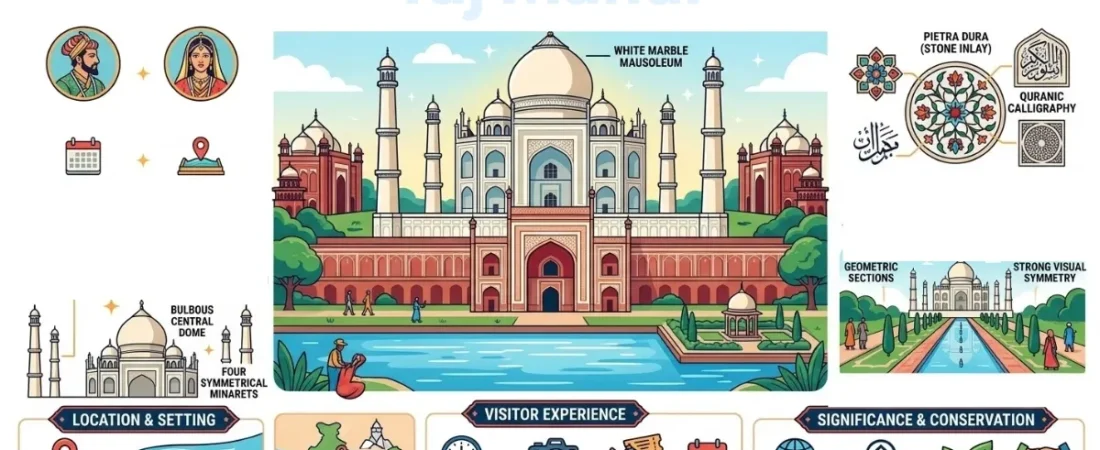
The Taj Mahal is one of the world’s most iconic monuments, admired for its breathtaking beauty, rich history, and extraordinary craftsmanship. Located beside the Yamuna River in Agra, this magnificent white marble monument was commissioned by Mughal emperor Shah Jahan in memory of Mumtaz Mahal. Built during the 17th century, it showcases the elegance of Mughal architecture through its grand dome, graceful minarets, intricate stone inlay, and symmetrical gardens. Recognized as a UNESCO World Heritage Site, the monument attracts travelers, photographers, and history enthusiasts from around the world. Beyond its romantic story, the Taj Mahal reflects India’s remarkable artistic heritage and remains an unforgettable highlight for anyone exploring Agra and its historic attractions.
What Is the Taj Mahal?
The Taj Mahal is a monumental mausoleum complex in Agra, created during the reign of Mughal emperor Shah Jahan. It was designed as the final resting place associated with Mumtaz Mahal and later Shah Jahan himself.
The complex is renowned for its balanced proportions, white marble surfaces, large central dome, four minarets, decorative calligraphy, stone inlay, carved marble screens, and Charbagh-style garden. Together, these elements demonstrate the sophistication of Mughal architecture.
Where Is the Taj Mahal Located?
The monument stands on the southern bank of the Yamuna River in Agra, Uttar Pradesh. Its riverside setting is an important part of its original architectural composition and contributes to several memorable views of the monument.
Agra is also home to other major Mughal-era attractions, making the city particularly suitable for travelers interested in Indian travel, history, architecture, and heritage tourism.
History of the Taj Mahal
The story of the monument is closely connected with Mumtaz Mahal, the wife of Shah Jahan. She died in 1631 after complications during childbirth, and the emperor commissioned an impressive mausoleum in her memory.
Construction began in Agra during the 17th century. Architects, craftsmen, stonecutters, calligraphers, engineers, and other specialists worked on different elements of the project, creating a complex that combined structural design with highly detailed decoration.
The principal mausoleum was completed during the Mughal period, while work on surrounding structures and decorative elements continued as the larger complex took shape. Over time, the monument became an enduring example of Mughal artistic and architectural achievement.
Why Was the Taj Mahal Built?
The primary purpose was to create a grand mausoleum for Mumtaz Mahal. Shah Jahan’s commission transformed a personal memorial into an ambitious architectural project.
The design also reflects broader Mughal ideas about geometry, gardens, water, paradise imagery, symmetry, and monumental architecture. For this reason, the monument can be understood through both its personal story and its wider cultural and religious context.
Taj Mahal Architecture
The architecture is distinguished by exceptional symmetry and carefully controlled proportions. The main mausoleum is faced with white marble and crowned by a large central dome, with four tall minarets positioned around the main structure.
Large arched entrances, domed chhatris, decorative panels, marble screens, and geometric forms create a harmonious composition. The designers combined Persian, Islamic, Indian, and Mughal architectural traditions rather than following a single architectural vocabulary.
The changing appearance of the marble throughout the day is another memorable feature. Morning, afternoon, and evening light can produce noticeably different impressions of the same structure.
The Main Dome and Minarets
The central dome is one of the monument’s defining visual features. Its bulbous form rises above the main chamber and is topped by a decorative finial, giving the mausoleum its instantly recognizable silhouette.
Four minarets surround the central structure and contribute to the overall symmetry. Their careful positioning also creates a strong visual frame around the main mausoleum when viewed from the garden.
Marble Inlay and Pietra Dura
The white marble surface contains extensive decorative work that becomes more impressive when viewed from close range. Floral motifs, geometric patterns, and other designs were created using highly skilled craftsmanship.
Pietra dura, a stone-inlay technique, was used to place carefully shaped pieces of colored and semi-precious stone into marble. The resulting floral and ornamental patterns add color without overwhelming the monument’s predominantly white appearance.
Quranic Calligraphy and Decorative Details
Calligraphy is an important part of the visual language of the complex. Quranic inscriptions appear around entrances and architectural surfaces, combining religious meaning with carefully planned artistic composition.
Visitors can also notice carved marble screens, floral motifs, geometric patterns, and delicate relief work. These details demonstrate why the monument deserves to be examined closely rather than appreciated only from its most famous viewpoint.
Inside the Taj Mahal
The interior chamber is more restrained than the exterior but contains intricate marble craftsmanship. The cenotaphs associated with Mumtaz Mahal and Shah Jahan are surrounded by an ornate marble screen featuring detailed carving.
One important distinction is that the visible cenotaphs are symbolic memorials rather than the actual graves. The burial chambers are located at a lower level, following the traditional arrangement of the mausoleum.
Photography and visitor access inside certain areas may be subject to specific rules, so travelers should follow the regulations in force on the day of their visit.
Taj Mahal Gardens
The formal gardens form an important part of the overall design. Their layout reflects the Charbagh tradition, where the garden is organized into geometric sections divided by pathways and water channels.
The long reflecting pools create strong visual symmetry and can mirror the central mausoleum under suitable conditions. The garden therefore functions as both landscaping and an architectural extension of the monument.
The relationship between the garden, main gateway, mausoleum, and Yamuna River contributes greatly to the sense of balance across the complex.
Taj Mahal UNESCO World Heritage Significance
The monument was recognized as a UNESCO World Heritage Site in 1983 for its outstanding cultural and architectural value. Its significance extends beyond its popularity as a tourist attraction.
The site represents an important achievement of Mughal architecture and demonstrates an exceptional combination of building design, landscape planning, decorative arts, and craftsmanship. Its international recognition also emphasizes the importance of long-term conservation.
Taj Mahal Visitor Information
Planning before arrival can help visitors avoid unnecessary delays. Entry arrangements, ticket categories, security requirements, visiting hours, and access rules can change, so current official information should always be checked before traveling.
Regular visitor access is not available on Fridays. Night viewing is also governed by specific dates, ticketing arrangements, and visitor restrictions rather than being a standard daily experience.
| Visitor detail | Information |
| Location | Agra, Uttar Pradesh |
| Setting | Yamuna River |
| Monument type | Mughal mausoleum complex |
| Main material | White marble |
| Architectural tradition | Mughal, Persian, Islamic and Indian influences |
| Regular weekly closure | Friday |
| Main features | Mausoleum, dome, minarets, gardens, gateway, mosque and jawab |
| Heritage status | UNESCO World Heritage Site |
Because admission prices and visitor regulations may be revised, travelers should verify the latest information to plan their budget accurately before purchasing tickets or beginning their journey.
Taj Mahal Ticket and Entry Planning
Ticket categories can vary depending on the visitor and the areas included in admission. The main complex and access to the inner mausoleum may involve different arrangements.
Visitors should purchase tickets through authorized channels and keep enough time for security checks and entry procedures. Carrying unnecessary items can make security screening more complicated, so checking current restrictions before arrival is useful.
Best Time to Visit the Taj Mahal
Early morning is a popular choice because the light can be softer and outdoor conditions are generally more comfortable than during the hottest part of the day. Sunrise also offers an appealing atmosphere for photography.
Winter is often preferred for sightseeing because temperatures in Agra are generally more manageable. During hotter months, visitors may find early morning or later afternoon more comfortable.
The best time ultimately depends on whether your priority is photography, comfortable weather, smaller crowds, or fitting the monument into a wider Agra itinerary.
Taj Mahal at Sunrise and Sunset
Sunrise provides one of the most atmospheric ways to experience the monument. The changing morning light can make the white marble appear warmer and more textured.
Later in the day, the monument takes on a different character as the sunlight changes. Rather than expecting one universally perfect viewing time, travelers can choose according to their preferred photography conditions and schedule.
How to Reach the Taj Mahal
Agra has rail and road connections with several major cities, making it accessible as part of a wider North India itinerary. Train travel is particularly convenient for visitors arriving from major urban centers.
Travelers arriving by road can use major highways connecting Agra with surrounding cities. Local taxis, auto-rickshaws, and other transport options are available for reaching the monument from different parts of the city.
If arriving on a busy sightseeing day, allow additional time for traffic, security checks, ticketing, and walking through the entrance area.
Taj Mahal Gates
The complex has multiple entry gates serving different approaches. The choice of gate can depend on current visitor arrangements and the direction from which you approach the monument.
Rather than relying on old travel instructions, check the latest entry information before your visit. Access arrangements can be modified for security, crowd management, or conservation requirements.
Best Places to See the Taj Mahal
The main garden provides the classic frontal view, with the gateway, reflecting pool, pathways, and mausoleum forming a highly symmetrical composition.
Mehtab Bagh, across the Yamuna River, offers a different perspective and is particularly interesting for travelers who want to see the monument from outside the principal complex.
The riverfront surroundings can also provide a quieter way to appreciate the relationship between the mausoleum and its broader landscape.
Photography at the Taj Mahal
The monument is naturally suited to photography because its appearance changes with distance, light, weather, and viewpoint. The central garden is ideal for the iconic symmetrical composition, while side angles can reveal more architectural detail.
Close-up photographs of marble inlay, calligraphy, carved screens, floral motifs, and stonework can add variety to a visit. Early morning light can be especially useful for avoiding harsh midday conditions.
Always follow current photography restrictions in areas where cameras or other equipment may not be permitted.
Places to Visit Near the Taj Mahal
A visit to Agra does not need to end at the main monument. Agra Fort provides another major connection with Mughal history and can help visitors understand the political and architectural environment of the period.
Mehtab Bagh is useful for a different view of the mausoleum, while other heritage sites and historic areas around Agra can be incorporated into a full-day sightseeing plan.
Combining several attractions also makes sense for travelers visiting Agra for only a short period.
Taj Mahal Conservation and Preservation
Preserving a historic marble monument that receives large numbers of visitors requires continuous care. Environmental conditions, pollution, weathering, biological growth, and visitor pressure can all affect historic materials.
Conservation therefore involves more than maintaining the visible white marble. The gardens, decorative elements, structural components, inscriptions, and surrounding environment also require protection.
Responsible tourism is an important part of preservation. Visitors can contribute by following entry rules, avoiding contact with delicate surfaces, disposing of waste properly, and respecting restricted areas.
Interesting Facts About the Taj Mahal
Although commonly described as a symbol of love, the monument has a much wider historical and cultural meaning. It represents an extraordinary combination of imperial patronage, religious ideas, landscape design, engineering, and decorative craftsmanship.
Its apparent simplicity from a distance can be deceptive. A closer look reveals thousands of individual design decisions, from the proportions of the buildings to the placement of marble inlay and calligraphic panels.
The complex was also designed as a unified environment rather than as a single isolated building. The gateway, garden, water features, mausoleum, mosque, jawab, and riverfront setting all contribute to the experience.
Must Read: Vamsadhara River
How Long Do You Need to Visit the Taj Mahal?
Most visitors should allow several hours rather than treating the monument as a quick photo stop. Time is needed for entry, security checks, walking through the gardens, exploring the mausoleum, and appreciating the architectural details.
If you are also visiting Agra Fort, Mehtab Bagh, or other attractions, planning a full day in Agra can make the itinerary more comfortable and less rushed.
Tips for a Better Visit
Comfortable footwear is useful because exploring the complex involves walking across gardens, pathways, and different visitor areas. Arriving with only permitted belongings can also make security procedures easier.
Keep your itinerary flexible enough to account for crowds, weather, transportation, and entry procedures. Most importantly, take time to observe details beyond the famous front-facing view.
The marble inlay, calligraphy, gardens, minarets, carved screens, and changing light are what turn a photograph of the monument into a much richer travel experience.
Conclusion
The Taj Mahal brings together history, Mughal architecture, white marble craftsmanship, gardens, calligraphy, and the enduring story of Shah Jahan and Mumtaz Mahal. Whether you visit for its architecture, cultural significance, photography, or historical importance, understanding the monument before arriving can make the experience far more rewarding.
FAQ’s
Who built the Taj Mahal?
The monument was commissioned by Mughal emperor Shah Jahan in memory of his wife, Mumtaz Mahal. Its construction involved numerous architects, craftsmen, artists, stoneworkers, and other specialists.
Why was the Taj Mahal built?
It was built as a mausoleum for Mumtaz Mahal after she died in 1631. The project developed into a major architectural and artistic achievement of the Mughal period.
Where is the Taj Mahal located?
It is located in Agra, Uttar Pradesh, on the southern bank of the Yamuna River. Agra is a major heritage destination with several other historic attractions.
When was the Taj Mahal built?
Construction began in the 17th century after Mumtaz Mahal’s death. The principal mausoleum was completed during the Mughal period, with additional work continuing on elements of the larger complex.
Is the Taj Mahal open every day?
Regular visitor access is not available on Fridays. Visiting arrangements can also vary for special occasions, conservation work, security requirements, or other official reasons.