
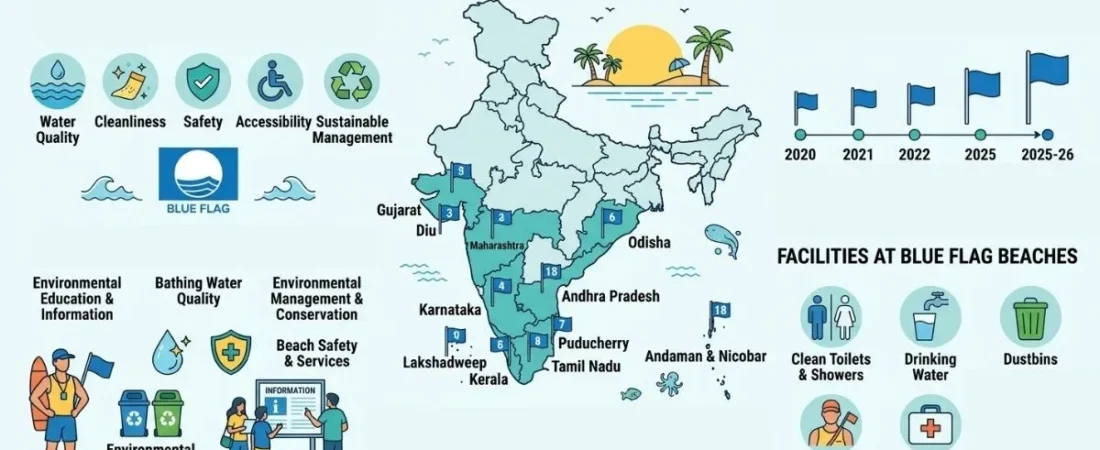
Blue Flag Beaches in India represent a new standard of coastal tourism, where natural beauty meets environmental responsibility. These beaches are recognized for maintaining high standards of water quality, cleanliness, safety, accessibility, and sustainable management. For the 2025–26 season, India achieved Blue Flag certification for 18 beaches across seven coastal states and four Union Territories. From Shivrajpur in Gujarat to Radhanagar in the Andaman Islands, these eco-friendly beaches offer travelers cleaner surroundings and better-managed coastal experiences. Whether you’re planning a relaxing beach holiday, exploring sustainable tourism, or looking for India’s most responsibly managed shores, understanding the Blue Flag programme can help you choose your next coastal destination wisely.
What Is a Blue Flag Beach?
Blue Flag is an internationally recognized voluntary eco-label for beaches, marinas, and sustainable tourism boats. To qualify, a site must meet and maintain strict environmental, educational, safety, accessibility, and management standards.
A Blue Flag isn’t simply an award for a clean shoreline. The programme evaluates issues such as bathing-water quality, waste management, environmental education, biodiversity, climate action, safety services, and accessibility. This makes certification relevant to both environmental protection and visitor experience in India.
How Many Blue Flag Beaches in India in 2026?
Blue Flag Beaches in India achieved certification for 18 beaches for the 2025–26 season, according to the Government of India’s April 2026 update. These beaches are spread across seven coastal states and four Union Territories.
India’s progress has been substantial. The first eight Indian beaches received Blue Flag certification in 2020, followed by Kovalam and Eden in 2021 and Minicoy Thundi and Kadmat in 2022.
The certification landscape can change between seasons because Blue Flag status depends on continued compliance. The international programme specifically warns that its standards are guaranteed only during the applicable Blue Flag season.
Blue Flag Beaches in India: Current List and Locations
The official national total is 18 for the 2025–26 season. Because individual online lists can differ by certification season, travelers should verify the current status before visiting. The following table reflects the 18-beach travel list commonly published for the current 2026 search landscape.
| Beach | State / UT | Location | Certification history |
| Shivrajpur Beach | Gujarat | Dwarka | First certified in 2020 |
| Ghoghla Beach | Diu | Diu | First certified in 2020 |
| Kasarkod Beach | Karnataka | Uttara Kannada | First certified in 2020 |
| Padubidri Beach | Karnataka | Udupi | First certified in 2020 |
| Kappad Beach | Kerala | Kozhikode | Certified in the 2025 season |
| Chal Beach | Kerala | Kannur | Certified in 2025 |
| Rushikonda Beach | Andhra Pradesh | Visakhapatnam | First certified in 2020 |
| Golden Beach | Odisha | Puri | First certified in 2020 |
| Radhanagar Beach | Andaman & Nicobar Islands | Swaraj Dweep | First certified in 2020 |
| Kovalam Beach | Tamil Nadu | Near Chennai | Certified in 2021 |
| Eden Beach | Puducherry | Puducherry | Certified in 2021 |
| Minicoy Thundi Beach | Lakshadweep | Minicoy | Certified in 2022 |
| Kadmat Beach | Lakshadweep | Kadmat | Certified in 2022 |
| Shrivardhan Beach | Maharashtra | Raigad | Added in 2025 |
| Nagaon Beach | Maharashtra | Raigad | Added in 2025 |
| Parnaka Beach | Maharashtra | Palghar | Added in 2025 |
| Guhagar Beach | Maharashtra | Ratnagiri | Added in 2025 |
| Ladghar Beach | Maharashtra | Ratnagiri | Added in 2025 |
The historical dates in the table should be understood as initial or reported certification milestones, not a guarantee that every beach retained the award continuously in every subsequent season. Blue Flag certification is subject to ongoing compliance and seasonal review.
How Blue Flag Beaches in India Have Grown Over Time
India’s first major group of eight certified beaches came in 2020. The initial group included Shivrajpur, Ghoghla, Kasarkod, Padubidri, Kappad, Rushikonda, Golden Beach, and Radhanagar.
In 2021, Kovalam Beach in Tamil Nadu and Eden Beach in Puducherry joined the certified network, taking the national tally to 10 at that time.
Two Lakshadweep beaches, Minicoy Thundi and Kadmat, were added in 2022, bringing the reported tally to 12.
Kappad and Chal in Kerala received Blue Flag recognition in 2025, while five beaches in Maharashtra—Shrivardhan, Nagaon, Parnaka, Guhagar, and Ladghar—were later reported as new additions.
This progression shows how India has moved from a small pilot group toward a broader model of sustainable coastal tourism.
Shivrajpur Beach, Gujarat
Shivrajpur Beach lies near Dwarka and was among India’s first eight Blue Flag beaches. Its location makes it especially convenient for travelers combining a beach holiday with Dwarka’s religious and cultural attractions.
The beach is a strong choice for travelers who want to combine coastal scenery with a Gujarat itinerary. Visitors should still check local sea conditions and available activities before entering the water.
Ghoghla Beach, Diu
Ghoghla is one of Diu’s better-known beaches and was part of India’s original Blue Flag group. Its broad shoreline and location near Diu’s historic attractions make it suitable for a relaxed coastal break.
Travelers can combine the beach with Diu Fort, local heritage sites, and other attractions. It works particularly well for visitors who want both beach time and cultural sightseeing.
Kasarkod Beach, Karnataka
Kasarkod Beach in Uttara Kannada was among India’s first certified beaches. It is associated with eco-friendly beach management and provides a quieter alternative to some of Karnataka’s more heavily visited coastal destinations.
Its natural setting makes it appealing to travelers interested in responsible tourism, peaceful beach walks, and coastal scenery.
Padubidri Beach, Karnataka
Padubidri Beach near Udupi was also part of the first group of eight Indian Blue Flag beaches. Its organized visitor environment makes it suitable for travelers looking for a cleaner and more managed coastal experience.
The beach can also fit naturally into a Karnataka itinerary covering Udupi, temples, local cuisine, and nearby coastal attractions.
Kappad Beach, Kerala
Kappad Beach in Kozhikode combines natural beauty with major historical significance. It is associated with the arrival of Vasco da Gama on the Malabar Coast and therefore appeals to travelers interested in both history and coastal tourism.
Kappad’s Blue Flag recognition also highlights Kerala’s emphasis on responsible tourism, environmental protection, safety, and sustainable beach management.
Chal Beach, Kerala
Chal Beach near Kannur is one of Kerala’s newer Blue Flag destinations. Kerala Tourism describes it as a model for responsible and sustainable tourism, with attention to environmental protection and visitor accessibility.
The beach is particularly attractive to families and nature lovers. Kerala Tourism highlights features including a designated swimming zone, eco-friendly facilities, a butterfly park, and environmental awareness initiatives.
Rushikonda Beach, Andhra Pradesh
Rushikonda Beach near Visakhapatnam is one of India’s original eight Blue Flag beaches. Its combination of golden sand, coastal scenery, and access to a major tourist city makes it a practical option for travelers exploring Andhra Pradesh.
Its proximity to Visakhapatnam also makes transport, accommodation, restaurants, and additional sightseeing easier to arrange than at many remote beach destinations.
Golden Beach, Odisha
Golden Beach in Puri combines beach tourism with Odisha’s famous cultural, adventurous, and spiritual attractions. Its location near the Jagannath Temple makes it especially interesting for travelers who want to combine coastal recreation with pilgrimage and heritage experiences.
The beach has also been used for environmental education and biodiversity-awareness initiatives, showing how Blue Flag certification can connect tourism with conservation.
Radhanagar Beach, Andaman and Nicobar Islands
Radhanagar Beach on Swaraj Dweep is one of India’s most famous tropical beach destinations. Its white sand, turquoise water, and surrounding greenery make it particularly attractive for travelers planning an island vacation.
It is one of the best beaches in India suited to visitors who want a scenic experience combined with the broader Andaman itinerary of islands, water activities, nature, and relaxation.
Kovalam Beach, Tamil Nadu
Kovalam near Chennai was added to India’s Blue Flag network in 2021. Its location close to Chennai makes it one of the more accessible certified beaches for travelers arriving through the city’s transport network.
The beach has included facilities such as a safe swimming zone, changing areas, showers, children’s facilities, drinking-water systems, and accessibility measures. However, swimming conditions can vary, so visitors should follow current local safety instructions.
Eden Beach, Puducherry
Eden Beach became one of India’s certified beaches in 2021. Its proximity to Puducherry makes it convenient for travelers who want to combine a beach visit with French colonial architecture, cafés, heritage streets, and cultural sightseeing.
Because Blue Flag status is seasonal and compliance-based, visitors should check the latest certification and facility information before traveling.
Minicoy Thundi Beach, Lakshadweep
Minicoy Thundi Beach offers a very different experience from mainland beaches. Its island setting, white sand, and lagoon environment make it appealing to travelers seeking a quieter tropical escape.
The beach received Blue Flag certification in 2022 along with Kadmat, taking India’s tally to 12 at that time.
Kadmat Beach, Lakshadweep
Kadmat is particularly attractive to travelers interested in island scenery and water-based experiences. Its lagoon environment and marine surroundings make it suitable for travelers planning snorkeling, diving, or other water activities where conditions and local regulations permit.
Because Lakshadweep requires more detailed transport planning than most mainland destinations, travelers should arrange permits, accommodation, and transfers before departure.
Maharashtra’s Five New Blue Flag Beaches
Maharashtra’s five additions—Shrivardhan, Nagaon, Parnaka, Guhagar, and Ladghar—are particularly important to India’s expanding Blue Flag story. They represent the growing focus on sustainable tourism along the Konkan coast.
Shrivardhan and Nagaon are in Raigad, Parnaka is in Palghar, while Guhagar and Ladghar are in Ratnagiri. Together, these destinations give travelers more opportunities to explore the Konkan coastline beyond Mumbai and Goa.
Shrivardhan Beach, Maharashtra
Shrivardhan is a scenic Konkan destination suitable for travelers looking for a quieter coastal experience. Its surroundings combine beaches, coconut groves, local culture, and traditional coastal landscapes.
It can work particularly well as part of a longer Konkan road trip rather than a quick standalone beach visit.
Nagaon Beach, Maharashtra
Nagaon is a popular coastal destination in Raigad and is known for its sandy shoreline and proximity to Alibaug. Its relatively accessible location makes it one of the more practical Maharashtra options for weekend travelers.
Visitors should check the latest water-sport availability and local beach rules before planning activities.
Parnaka Beach, Maharashtra
Parnaka Beach in Palghar represents one of the newer destinations within India’s Blue Flag landscape. It offers travelers an opportunity to explore a less internationally familiar section of Maharashtra’s coastline.
Its growing recognition also makes it an interesting option for travelers who prefer emerging destinations over heavily commercialized beaches.
Guhagar Beach, Maharashtra
Guhagar is known for its long Konkan shoreline and quieter atmosphere. The destination suits travelers who want to slow down, enjoy coastal scenery, and combine beach time with local food and village experiences.
It can also fit into a wider Ratnagiri and Konkan itinerary.
Ladghar Beach, Maharashtra
Ladghar is another Ratnagiri destination added to the Blue Flag network. Its relatively peaceful setting makes it appealing to travelers looking for a more relaxed coastal escape.
Its position in the Konkan region means travelers can combine it with other beaches, temples, forts, and local attractions during a road trip.
What Are the Blue Flag Certification Criteria?
Blue Flag certification is based on stringent standards covering environmental quality, visitor safety, accessibility, education, and sustainable management. The current international framework highlights areas including water quality, waste management, biodiversity protection, climate action, environmental education, safety, and accessibility.
Historically, Indian government material described the programme through 33 criteria grouped into four broad categories: environmental education and information, bathing-water quality, environmental management and conservation, and beach safety and services. The current international framework has evolved to emphasize six broader areas.
This distinction is useful because many older articles still describe only the original four-category structure.
Why Blue Flag Certification Matters for India
India’s coastline supports tourism, biodiversity, fishing communities, and local economies, but coastal areas also face pollution, plastic waste, erosion, overcrowding, and pressure from poorly managed tourism.
Blue Flag certification encourages destinations to improve water-quality monitoring, waste management, visitor safety, environmental education, accessibility, and sustainable coastal practices. The Government of India describes Blue Flag beaches as sites maintaining international standards of cleanliness, water quality, safety, and sustainable management.
The result is a tourism model where environmental protection becomes part of the visitor experience rather than an afterthought.
Which Blue Flag Beach Is Best for You?
The best destination depends on what kind of trip you want. Radhanagar is particularly attractive for island vacations, while Golden Beach is ideal for travelers who want to combine beach time with spiritual and cultural tourism.
Kappad works well for history lovers, Shivrajpur suits travelers exploring Dwarka and Gujarat, and Kovalam is convenient for visitors based around Chennai.
Families may prefer beaches with clearly managed facilities and designated swimming areas, while nature lovers may enjoy quieter destinations such as Kasarkod, Padubidri, or the Konkan beaches.
For water-sports enthusiasts, island destinations such as Kadmat can be especially appealing, although activities depend on local operators, weather, sea conditions, and current regulations.
Best Time to Visit Blue Flag Beaches in India
There is no single best month for every certified beach because India has several coastal climatic zones. For many destinations, October to March offers comfortable weather for sightseeing, beach walks, and outdoor activities.
The situation can differ considerably in Kerala, Maharashtra, Odisha, Gujarat, Tamil Nadu, Andaman and Nicobar, and Lakshadweep. Monsoon conditions can bring heavy rainfall and rough seas, making some activities unsuitable.
Travelers should also remember that Blue Flag standards are guaranteed only during the applicable Blue Flag season. Checking the current seasonal status before visiting is therefore more reliable than assuming certification is permanent.
Facilities at Blue Flag Beaches
Blue Flag standards encourage beaches to provide a combination of environmental and visitor facilities. Depending on the destination, these can include sanitation, drinking water, waste-management systems, first-aid arrangements, safety services, environmental information, and accessible infrastructure.
Facilities vary from beach to beach, so don’t assume every certified destination offers identical services. Check local information before relying on a particular facility, especially when traveling with children, elderly visitors, or people with accessibility requirements.
How to Reach Blue Flag Beaches in India
Mainland beaches such as Shivrajpur, Kappad, Golden Beach, Kovalam, and Rushikonda are relatively straightforward to include in wider travel itineraries because they are connected to established cities and transport networks.
Island destinations require more planning. Radhanagar involves travel through the Andaman transport network, while Lakshadweep destinations such as Minicoy and Kadmat require planning for permits, accommodation, transfers, and island connectivity.
For every destination, check the nearest airport or railway station, road distance, local transport, weather, and accommodation availability before finalizing your itinerary.
Blue Flag Beaches and Sustainable Tourism
Blue Flag certification is closely connected with sustainable tourism because environmental quality is part of the certification itself. The programme encourages destinations to protect biodiversity, manage waste, educate visitors, improve accessibility, and reduce environmental pressure.
For travelers, sustainable beach tourism means respecting the destination rather than simply consuming it. Avoid littering, reduce unnecessary plastic use, stay within designated areas, follow lifeguard instructions, and never disturb marine animals, dunes, vegetation, or other sensitive habitats.
Are Blue Flag Beaches in India the Cleanest?
Blue Flag Beaches in India are often described as among the cleanest and best-managed coastal destinations, but the term should be used carefully. Blue Flag is not simply a ranking of beaches from cleanest to dirtiest.
Instead, it is a certification system based on defined environmental, safety, educational, accessibility, and management standards. A beautiful beach without Blue Flag certification isn’t necessarily inferior; it simply hasn’t been assessed or awarded under the same programme.
What Should You Check Before Visiting a Blue Flag Beach?
Certification should be treated as one part of your travel planning rather than a guarantee of identical conditions every day. Weather, tides, sea conditions, maintenance, visitor numbers, and local regulations can change.
Before your trip, check the beach’s current certification season, swimming conditions, local safety notices, available facilities, transport, accommodation, and permitted activities. This is especially important for island destinations and beaches affected by seasonal weather.
The Blue Flag International programme specifically advises visitors to check the applicable season because the Blue Flag standard is guaranteed only during that period.
Conclusion
The Blue Flag Beaches in India network reflects India’s growing focus on cleaner coastlines, safer recreation, environmental education, accessibility, and sustainable tourism. With 18 beaches recognized for the 2025–26 season, travelers can explore diverse coastal destinations across Gujarat and Maharashtra, Kerala, Odisha, Tamil Nadu, Lakshadweep, and the Andaman Islands. Check the current certification season before traveling, choose a destination that matches your interests, and follow responsible beach practices to help protect India’s coastline for the future.
FAQ’s
Where are the most Blue Flag beaches?
Spain has the most Blue Flag beaches in the world in 2026, with 677 certified beaches. It remains the global leader in the Blue Flag programme.
Which is the first beach in India to get a Blue Flag?
India’s first Blue Flag certification was awarded to eight beaches in 2020, rather than one single beach. These included Shivrajpur, Ghoghla, Kasarkod, Padubidri, Kappad, Rushikonda, Golden Beach, and Radhanagar.
What are the top 10 beaches in India?
Popular top beaches include Radhanagar, Golden Beach, Shivrajpur, Kappad, Rushikonda, Kovalam, Padubidri, Kasarkod, Ghoghla, and Eden Beach. The best choice depends on scenery, activities, location, and travel preferences.
Which beach in India has the 13th Blue Flag?
There isn’t a single officially designated “13th Blue Flag beach” in India because certification is awarded by season rather than as a numbered ranking. India’s certified beaches expanded over multiple award cycles.