
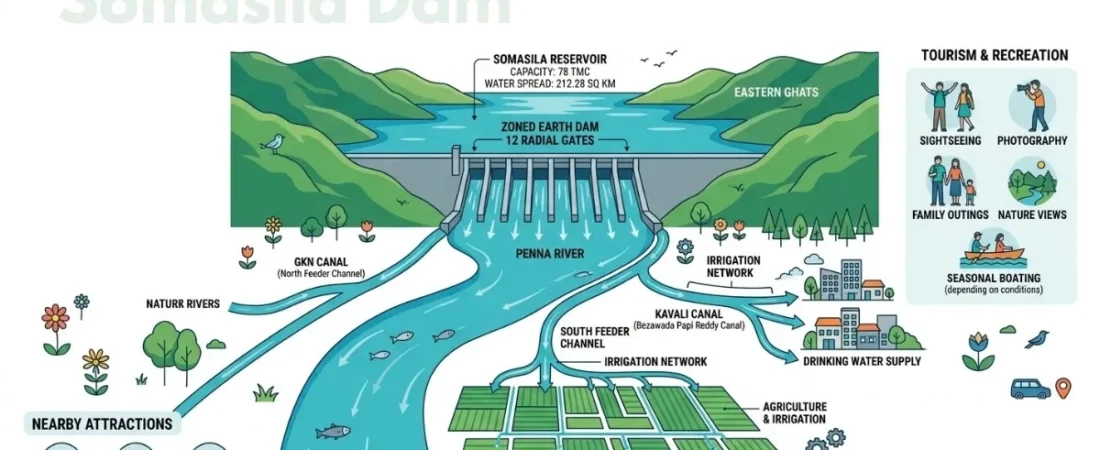
Somasila Dam is a remarkable destination in Andhra Pradesh, built across the Penna River in Nellore district. Beyond its importance as a major irrigation project, the reservoir attracts travellers with peaceful waters, scenic hills, and beautiful nature views. The surrounding Eastern Ghats create a refreshing setting for sightseeing, photography, and relaxed family outings. The Somasila Reservoir also plays an important role in regional water storage and agriculture, making it significant from both environmental and economic perspectives. Visitors can explore the area’s natural beauty while learning about its engineering and water management importance. With nearby attractions, pleasant seasonal scenery, and easy road access, Somasila offers an interesting experience for travellers exploring Nellore tourism and Andhra Pradesh.
Where Is Somasila Dam Located?
Somasila Dam is located near Somasila village in Ananthasagaram Mandal of Sri Potti Sriramulu Nellore district, Andhra Pradesh. The project lies across the Penna River in the Pennar River basin, with the Eastern Ghats forming part of the surrounding landscape.
From Nellore, Somasila is a useful destination for Indian travellers looking for a quieter experience away from the city. The district administration lists it among the area’s important water bodies and dams, and its scenic setting has helped it develop as an eco-tourism attraction.
Somasila Dam History and Construction
The Somasila irrigation project was planned as a major water-resource development for the region. Its foundation stone was laid on June 4, 1975, and construction of the dam and associated works commenced in 1976.
The main dam and appurtenant works were completed in 1989. The project was designed to store Penna River water and distribute it through an extensive canal system, helping stabilize existing agricultural areas while creating additional irrigation potential.
Somasila Dam Key Facts
The scale of the project becomes clearer when its reservoir, dam, and spillway specifications are considered together. Official project information gives a gross reservoir capacity of about 78 TMC at full reservoir level, while the live storage is listed separately according to the project’s engineering measurements.
| Feature | Details |
| Location | Somasila, Ananthasagaram Mandal, Nellore district |
| State | Andhra Pradesh |
| River | Penna River |
| River basin | Pennar Basin |
| Project | Somasila Irrigation Project |
| Gross reservoir capacity | About 78 TMC |
| Water-spread area at FRL | About 212.28 sq km |
| Dam type | Zoned earth dam with associated masonry structures |
| Dam height | About 38 metres |
| Main spillway | Ogee type |
| Spillway gates | 12 radial gates |
| Main purpose | Irrigation and water management |
| Tourism appeal | Reservoir views, hills, nature and sightseeing |
The project includes three principal canals: the GKN Canal or North Feeder Channel, the South Feeder Channel, and the Bezawada Papi Reddy Canal, also known as the Kavali Canal. Together, these systems connect the reservoir with a much wider irrigation network.
Why Is Somasila Dam Important?
The importance of Somasila goes far beyond its appearance as a large reservoir. It was developed to support irrigation, stabilize agricultural areas, and manage water resources across several parts of Nellore and surrounding regions.
The project has also been associated with drinking-water supply and broader regional water distribution. Its scale means that changes in reservoir storage can have significance for agriculture and communities that depend on the connected water infrastructure.
Irrigation and Agriculture
Agriculture is one of the principal reasons for the project’s development. The canal network carries stored water toward agricultural areas, helping stabilize wet ayacut and support irrigation in drought-prone upland regions.
The official project profile states that the scheme was planned to stabilize 4,05,500 acres of wet ayacut and create irrigation potential for an additional 1,79,000 acres, giving a total contemplated ayacut of 5,84,500 acres.
Water Supply and Regional Development
The project also has a wider water-management role. Its planned objectives include supplying water for domestic requirements, supporting towns and villages, and transferring water toward other connected reservoirs and schemes.
This combination of irrigation, drinking water, reservoir storage, and water transfer makes Somasila an important part of the region’s long-term water infrastructure rather than simply a local tourist attraction.
Somasila Dam and the Penna River
The Penna River is central to understanding the project. The reservoir captures and regulates water within the Pennar basin, while additional water can reach the reservoir through connected water-resource systems.
The surrounding landscape adds another dimension to the river and reservoir environment. The Eastern Ghats around the project create a scenic backdrop, giving visitors opportunities to experience both an important engineering project and a natural setting.
Somasila Dam as a Tourist Destination
Although its primary purpose is water management, the reservoir has developed into a destination for visitors interested in nature, scenery, and engineering tourism. The broad water spread and hills create attractive views, particularly when weather conditions are pleasant.
The area is suitable for a relaxed outing rather than a highly commercialized sightseeing experience. Visitors can spend time enjoying the landscape, taking photographs, and exploring the surroundings while learning about the importance of the irrigation project.
Things to Do at Somasila Dam
Sightseeing is one of the simplest ways to enjoy the destination. The reservoir and surrounding hills provide open views that work particularly well for landscape photography, especially during the early morning or late afternoon.
Visitors can also plan a short picnic-style outing and explore the natural surroundings. Boating or other recreational activities should not be assumed to operate throughout the year, as availability can depend on local management, water conditions, and safety restrictions.
Best Time to Visit Somasila Dam
October to February is generally a comfortable period for exploring the area because outdoor conditions are usually more pleasant. The post-monsoon landscape can also provide attractive greenery and fuller reservoir surroundings.
Summer can be hot, particularly during the afternoon, so early morning or late-day visits are more comfortable. The monsoon season may bring greener scenery, but heavy rainfall can affect road conditions and visitor activities, making it important to check local conditions before travelling.
Somasila Dam Timings and Visitor Information
Visitors should avoid relying on a permanent opening time unless it has been confirmed locally for the day of travel. Access, recreational activities and facilities can change because of weather, water levels, maintenance or local safety requirements.
For a comfortable and budget-friendly visit, carry drinking water, sun protection, comfortable footwear and basic travel essentials. Stay within designated visitor areas and follow safety instructions around the reservoir, spillway, canals and other restricted project infrastructure.
How to Reach Somasila Dam
Road travel is the most practical option for reaching the Somasila area. Travellers coming from Nellore can continue by road toward Ananthasagaram and Somasila, using current navigation information for the final part of the journey.
Visitors arriving from other cities can first reach Nellore by road or rail and then continue toward the reservoir. Nellore railway station is connected to major rail routes, while travellers arriving by air generally need to continue their journey by road from a nearby airport.
By Road
A road trip is particularly convenient for travellers who want to combine the reservoir with other attractions. Current navigation is recommended because travel time can vary according to the starting point, traffic, and road conditions.
By Train
Nellore is the practical railway gateway for many travellers. After reaching Nellore railway station, the remaining journey to Somasila can be completed by road.
By Air
Nellore does not currently have its own commercial airport. Tirupati and Chennai are among the major airport or airline options used for reaching the broader Nellore region, after which travellers need onward road transport.
Somasila Dam Distance and Travel Planning
The actual travel distance depends on where your journey begins. For travellers staying in Nellore, Somasila can be planned as a day trip, while visitors travelling from farther cities may prefer to combine it with several destinations across the district.
The district’s tourism information places Somasila about 79 km from Nellore in its list of water bodies and dams. Because route conditions and starting locations vary, travellers should check the current road route before departure.
Places to Visit Near Somasila Dam
A trip to Somasila can be combined with other attractions in the wider Nellore region. Depending on your route and interests, you can explore religious sites, beaches, reservoirs, scenic areas, and wildlife destinations.
The surrounding district includes attractions such as Penchalakona, Mypadu Beach, Ramatheertham Beach, Kandaleru Reservoir, and other water bodies. Choosing nearby destinations according to your route can turn a short reservoir visit into a more complete Nellore travel itinerary.
Somasila Dam for Nature and Photography
The reservoir’s open water and Eastern Ghats setting are among its strongest visual attractions. The changing light across the water, hills, and surrounding vegetation can provide excellent opportunities for landscape photography.
Nature lovers can also enjoy the quieter atmosphere compared with crowded urban attractions. However, visitors should respect the environment, avoid littering, and never enter restricted areas simply to obtain a better photograph.
Conclusion
Somasila combines a major irrigation project with a peaceful reservoir landscape surrounded by the Eastern Ghats. Its importance for agriculture, water management, and regional development, together with opportunities for sightseeing and nature photography, makes Somasila Dam a worthwhile addition to a Nellore travel itinerary.
FAQ’s
Where is Somasila Dam located?
Somasila Dam is located near Somasila village in Ananthasagaram Mandal of Nellore district, Andhra Pradesh. It is constructed across the Penna River in the Pennar basin.
What is the capacity of Somasila Reservoir?
The project’s gross storage capacity is about 78 TMC at full reservoir level. Official project specifications separately identify live storage and other reservoir levels, so different technical sources may quote different capacity figures depending on the measurement being discussed.
Is boating available at Somasila?
Boating should be treated as a seasonal or locally managed activity rather than a guaranteed facility. Availability can depend on water conditions, safety requirements, and local operations, so confirm before your visit.
How can I reach Somasila?
Road travel is the most practical option. Travellers can reach Nellore by train or road and continue toward Somasila, while visitors arriving by air need onward road transport from a nearby airport.
What can I see near Somasila?
The wider Nellore region offers beaches, temples, reservoirs, scenic areas, and other attractions. Penchalakona, Kandaleru Reservoir, and several coastal destinations can be considered depending on your route and available time.