
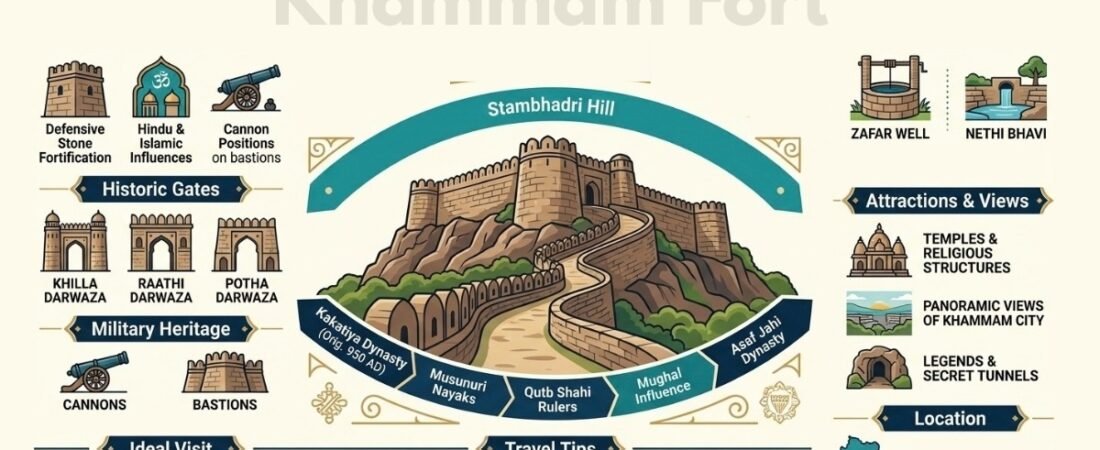
Rising majestically on Stambhadri Hill, Khammam Fort is a fascinating historic landmark that reflects the rich heritage of Telangana. Built as a strategic hill fort, it has witnessed the influence of powerful dynasties, including the Kakatiyas, Musunuri Nayaks, and Qutb Shahi rulers. Its massive stone walls, ancient gateways, bastions, and traditional water structures reveal the importance of military planning in earlier centuries. Today, the fort attracts travelers interested in Telangana heritage, historical architecture, and panoramic views of Khammam. From exploring its historic gates to discovering old wells and religious structures, a visit offers a glimpse into the region’s fascinating past. This guide covers its history, architecture, attractions, travel information, and practical tips for visitors planning their trip.
Khammam Fort at a Glance
| Feature | Details |
| Location | Khammam, Telangana |
| Setting | Stambhadri Hill |
| Type | Historic hill fort |
| Historical association | Kakatiyas, Musunuri Nayaks, Qutb Shahis and Asaf Jahis |
| Main attractions | Gates, bastions, walls, cannons, wells and religious structures |
| Architecture | Defensive stone fortification with Hindu and Islamic influences |
| Best for | History, heritage, architecture and sightseeing |
| Ideal visiting period | Cooler months and comfortable morning or evening hours |
Its location within Khammam makes it convenient to include in a city sightseeing plan. Travelers can explore the fort and then continue to other attractions in and around the district.
History of Khammam Fort
The history of the fort stretches back many centuries, with its origins traditionally associated with the Kakatiya period. Historical accounts commonly place its construction around 950 AD, although descriptions of its early development vary between sources.
The fort was subsequently strengthened and developed under the Musunuri Nayaks and Qutb Shahi rulers. Later political changes brought the wider region under Mughal influence and eventually the Asaf Jahi dynasty, adding further layers to its historical story.
Rather than belonging to a single period, the monument reflects successive phases of Telangana’s history. Its surviving walls and structures therefore provide evidence of how a strategic hill settlement evolved as different powers controlled the region.
Why Was Khammam Fort Built?
Its elevated position on Stambhadri Hill gave the fort an important natural defensive advantage. From higher ground, soldiers could observe the surrounding landscape while the fortified walls and bastions provided additional protection.
The design also reflects the practical needs of a self-contained stronghold. Controlled gateways, defensive positions, water sources, and strategically placed structures helped support life within the fort during periods of political uncertainty or conflict.
Architecture of Khammam Fort
The architecture is dominated by rugged stone construction and heavy defensive features. Thick walls follow the contours of the hill, while bastions and elevated positions strengthened the fort’s ability to monitor and defend its surroundings.
The complex also demonstrates how architectural traditions changed over time. Hindu religious structures and later Islamic influences exist within the broader historic landscape, creating a distinctive combination of cultural and architectural elements.
Khammam Fort Walls and Bastions
The massive ramparts are among the most impressive remnants of the historic complex. Built to withstand attacks and control access, these defensive walls also emphasize the strategic importance of the hill.
Bastions provided elevated positions from which defenders could observe approaching forces and operate weapons. Some surviving sections also contain cannon positions, giving visitors an idea of how military technology influenced the fort’s later defensive arrangements.
Historic Gates of the Khammam Fort
The gateways were critical to the fort’s security because they controlled movement between the outside landscape and the protected interior. Khilla Darwaza is among the notable entrances associated with the historic site.
Other traditional gateways, including Raathi Darwaza and Potha Darwaza, are part of the fort’s architectural heritage. Their scale and construction demonstrate how entrances to hill forts were designed as controlled defensive points rather than ordinary passages.
Cannons and Military Heritage
The presence of cannons adds another dimension to the fort’s military history. Positioned around strategic sections of the fortifications, such weapons could be used to defend important approaches and strengthen the hilltop position.
Today, these remnants are valuable historical features because they connect the older stone fortification system with later developments in warfare. Together with the bastions and ramparts, they help visitors understand the defensive purpose of the site.
Wells and Ancient Water Management
Water was essential to the survival of any large hill fort. During periods of conflict, residents and soldiers could not always depend on supplies from outside, making permanent water sources an important part of fort planning.
Historic features such as Zafar Well and Nethi Bhavi are associated with the site’s traditional water-management system. These structures demonstrate the practical engineering used to support habitation within a fortified hill environment.
Temples and Religious Structures
The fort’s heritage is not limited to military architecture. Religious structures within the historic landscape reflect the cultural changes that occurred as different communities and rulers became connected with the region.
Hindu temples and Islamic architectural elements contribute to the site’s layered identity. Exploring these structures alongside the defensive walls gives visitors a broader understanding of the fort as a place where military, religious, administrative, and everyday activities once intersected.
Legends and Secret Tunnel Stories
Old forts naturally attract stories, and this one is no exception. Local traditions include tales of underground or secret passages that were supposedly used to connect the fort with other locations.
These accounts are best understood as local legends rather than established archaeological facts. Their uncertain nature does not make them uninteresting, however, and they add an element of mystery to the experience of exploring an ancient hill fort.
Must Read: NTR Gardens
Khammam Fort Timings and Entry Fee
Visitors should verify the latest local access information before traveling because opening arrangements, maintenance work, and visitor regulations can change. Information found online may not always reflect conditions on the day of your visit.
If access is available, allow sufficient time to walk through the historic area rather than treating it as a quick photo stop. Uneven surfaces and elevated sections can make comfortable footwear particularly useful.
Best Time to Visit Khammam Fort
The cooler months are generally more comfortable for exploring the exposed hilltop surroundings. Morning and late-afternoon visits can also be pleasant because temperatures are usually more manageable than during the middle of the day.
Summer afternoons can be hot, while rain may make stone surfaces slippery. Travelers should check the weather before setting out and carry water, especially when planning a longer exploration of the fort.
How to Reach Khammam Fort
Khammam is connected to major cities in Telangana and neighboring regions by road and rail. Travelers arriving by train can use local transportation for the remaining journey because the fort is located within the Khammam urban area.
Those traveling from Hyderabad can choose between road and railway connections before continuing locally toward the historic site. Current train schedules, road conditions, and local transport availability should be checked before departure.
Distance From Khammam Railway Station
One advantage for visitors is the fort’s proximity to the city’s main transport network. Khammam Railway Station is relatively close to the historic hill, making a local taxi, auto-rickshaw, or other city transport a practical option.
The exact travel time can vary with traffic and the chosen route. Travelers who want to explore several Khammam attractions on the same day may find local transportation more convenient than arranging separate long-distance journeys.
Things to See at Khammam Fort
A visit is more rewarding when you explore the site as a complete historic landscape rather than focusing only on its main entrance. The ramparts, gates, bastions, cannons, wells, temples, and other surviving structures each reveal a different aspect of its past.
The elevated setting is another attraction. Depending on weather and visibility, visitors can enjoy views across Khammam while photographing the contrast between the old stone fortifications and the modern city surrounding them.
Things to Know Before Visiting
An old hill fort does not offer the same facilities as a modern tourist attraction. Some sections may have uneven ground, weathered masonry, slopes, or steps, so visitors should plan accordingly and avoid climbing restricted structures.
Carry drinking water and sun protection during warmer weather, and wear shoes suitable for walking on uneven surfaces. Planning your budget can also help you manage small travel expenses comfortably. Respecting the walls, inscriptions, religious structures, and other remains is essential for preserving the heritage site for future visitors.
Must Read: Vamsadhara River
Places to Visit Near Khammam Fort
Khammam can be explored as a broader sightseeing destination rather than a single-attraction stop. Visitors with additional time can plan other historical or religious, natural, and recreational attractions in the surrounding area.
A day itinerary can combine the fort with nearby attractions depending on opening hours, travel time, and personal interests. Checking current local access information before building the itinerary can prevent unnecessary detours.
Must Read: Triveni Sangam
Why Visit Khammam Fort?
For travelers interested in heritage, the attraction lies in the way several historical themes come together in one location. The fort combines military planning, hilltop geography, traditional water management, religious architecture, and the history of successive ruling powers.
It is also a good choice for travelers who prefer exploring less conventional heritage destinations. Instead of simply viewing a monument from outside, visitors can observe its defensive layout and imagine how the hill once functioned as a protected settlement.
Must Read: Tenneti Beach Park
Conclusion
Khammam Fort offers a fascinating combination of Telangana history, hill-fort architecture, defensive structures, ancient water systems, religious heritage, and local legends. From its gateways and bastions to its hilltop setting, the historic site provides a meaningful glimpse into Khammam’s past and is a worthwhile addition to a heritage-focused Telangana itinerary.
FAQ’s
What is Khammam Fort famous for?
It is famous for its historic hilltop location, massive fortifications, gateways, bastions, cannons, wells, and architectural remains associated with several ruling dynasties. Its combination of military and cultural heritage makes it an important historical attraction in Khammam.
Who built Khammam Fort?
The fort is traditionally associated with the Kakatiya period, with historical accounts commonly placing its origins around 950 AD. It was later strengthened and developed under different ruling powers, including the Musunuri Nayaks and Qutb Shahis.
How old is Khammam Fort?
Its origins are generally associated with the medieval period and are commonly dated to around the 10th century. Because historical accounts differ on some details of its early development, specific dates should be treated with appropriate historical context.
Where is Khammam Fort located?
The fort is situated on Stambhadri Hill in Khammam, Telangana. Its location within the city makes it relatively accessible for travelers planning a Khammam sightseeing itinerary.
How can I reach Khammam Fort from Hyderabad?
Travelers can reach Khammam from Hyderabad by road or train and then use local transportation to reach the fort. The best option depends on the current transport schedule, budget, and preferred travel time.