
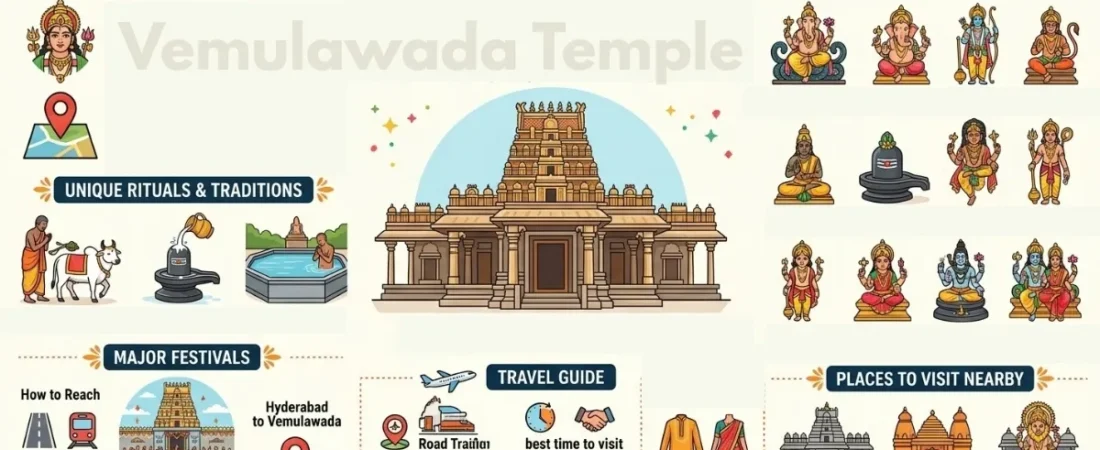
Vemulawada Temple is one of Telangana’s most revered pilgrimage destinations, dedicated to Sri Raja Rajeshwara Swamy, a sacred form of Lord Shiva. Located in Rajanna Sircilla district, this ancient shrine is celebrated for its rich heritage, spiritual atmosphere, and unique traditions. Devotees visit to seek blessings, perform Kode Mokku, attend Abhishekam, and experience the peaceful surroundings of this historic Shiva temple. Often associated with the title Dakshina Kasi, Vemulawada holds a special place in South Indian pilgrimage traditions. The temple complex also features several important shrines and the sacred Dharma Gundam. With its fascinating temple history, religious significance, and distinctive rituals, Vemulawada offers a memorable experience for devotees, history enthusiasts, and travellers exploring Telangana.
Vemulawada Temple at a Glance
| Information | Details |
| Temple Name | Sri Raja Rajeshwara Swamy Temple |
| Main Deity | Raja Rajeshwara Swamy |
| Location | Vemulawada, Telangana |
| District | Rajanna Sircilla |
| Religious Tradition | Shaivism |
| Popular Name | Rajanna Temple |
| Famous As | Dakshina Kasi |
| Major Ritual | Kode Mokku |
| Sacred Water Body | Dharma Gundam |
| Major Festival | Maha Shivaratri |
| Best For | Pilgrimage, spirituality, culture and heritage |
The shrine attracts devotees from Telangana and other parts of India throughout the year. Its importance comes not only from its principal deity but also from the collection of sacred shrines, religious traditions, festivals, and historical associations found within the temple complex.
Why Is Vemulawada Temple Famous?
The main attraction is Sri Raja Rajeshwara Swamy, worshipped as a revered form of Lord Shiva. Devotees visit the shrine to seek blessings, perform prayers, offer Abhishekam, participate in sevas, and fulfil religious vows.
The temple is especially known for Kode Mokku, a distinctive ritual involving a sacred bull. Its association with Dakshina Kasi, Dharma Gundam, and the ancient heritage of the Vemulawada Chalukyas further adds to its religious and cultural importance.
History of Vemulawada Temple
The history of the temple is closely associated with the Vemulawada Chalukyas, who ruled parts of the Deccan between approximately the eighth and tenth centuries. Historical remains, inscriptions, literary references, and local traditions indicate that Vemulawada developed into an important centre of religion and culture.
The temple’s past is also connected with several traditional legends and the local Sthalapurana. These stories form an important part of the faith surrounding the shrine, although religious traditions and historical facts should be understood separately.
Over the centuries, the temple complex developed into a major pilgrimage centre where Shaiva and Vaishnava traditions can be experienced together.
Religious Significance of Rajanna Temple
Sri Raja Rajeshwara Swamy is the presiding deity of the shrine, and devotees commonly refer to the deity with affection as Rajanna. The sacred Shiva Lingam is the spiritual centre of the temple and is the focus of daily worship.
Vemulawada is traditionally called Dakshina Kasi because of its deep connection with Lord Shiva and its importance as a southern pilgrimage centre. The temple is also associated with the names Harihara Kshetram and Bhaskara Kshetram, reflecting the diverse religious traditions connected with the sacred complex.
Important Shrines Inside the Temple Complex
A visit to the temple is not limited to the main Raja Rajeshwara Swamy shrine. Several other deities and smaller shrines contribute to the religious character of the complex.
Visitors may encounter shrines associated with deities such as Anantha Padmanabha Swamy, Siddi Vinayaka, Lord Rama, Anjaneya, Kasi Visweswara, Dakshinamurthy, Subramanya, Bala Tripura Sundari, Someshwara and Uma Maheshwara.
This combination of Shaiva and Vaishnava traditions gives the pilgrimage a distinctive character and allows devotees to experience several forms of Hindu worship within the same temple complex.
Kode Mokku at Vemulawada
Kode Mokku is one of the most famous religious traditions associated with Vemulawada. The ritual involves a bull and is performed by devotees as an act of devotion and fulfilment of religious vows.
The tradition has a close association with the temple’s Shaiva identity and the sacred symbolism of the bull. Visitors interested in performing Kode Mokku should follow the current procedure and instructions provided by the temple authorities, as arrangements may vary.
For many pilgrims, this ritual is one of the most memorable parts of visiting the shrine and is an important reason why Vemulawada has a distinctive place among Telangana pilgrimage destinations.
Dharma Gundam and Its Importance
Dharma Gundam is an important sacred feature associated with the temple. The water body has religious significance and forms part of the traditional pilgrimage experience at Vemulawada.
Its presence adds another dimension to the visit because the temple complex combines worship, sacred water traditions, historic structures, and devotional practices. Visitors should follow the instructions and safety arrangements in place when approaching or using any sacred water area or lake.
Vemulawada Temple Timings and Darshan
The temple follows a daily schedule for darshan, worship, and various religious services. However, timings can change during festivals, special occasions, important rituals, and administrative changes.
Visitors should therefore verify the latest schedule before travelling, particularly when planning a specific seva or Abhishekam. Arriving early on an ordinary day can make the pilgrimage more comfortable and may provide more time for darshan and exploring the temple complex.
During Maha Shivaratri and other major festivals, the number of devotees can increase significantly. Pilgrims should expect longer queues and allow additional time for darshan.
Pujas, Sevas and Abhishekam
Religious services are a major part of the pilgrimage experience. Depending on the current temple schedule, devotees can participate in different forms of worship and special sevas associated with Raja Rajeshwara Swamy.
Important services may include Abhishekam, Rudrabhishekam, Anna Puja, Kalyanam, Kumkuma Puja, Pallaki Seva, and other traditional offerings. Each service can have its own timing, procedure, eligibility, and booking requirements.
If you plan to participate in a particular seva, check its current availability and procedure before your journey. This is especially important during busy periods when popular services may have limited availability.
Vemulawada Temple Festivals
Maha Shivaratri is one of the most important festivals celebrated at the shrine. The occasion attracts large numbers of Shiva devotees and creates a particularly vibrant atmosphere around the temple.
Other religious celebrations are also observed throughout the year, including festivals connected with the wider Hindu calendar. Festival dates can be especially busy, so visitors should arrange transportation and accommodation well in advance.
A festival visit can be spiritually rewarding, but travellers should also prepare for larger crowds, traffic restrictions, longer queues, and increased demand for local facilities.
Best Time to Visit Vemulawada
The best time to visit depends on the experience you want. If your priority is a relatively peaceful darshan, an ordinary weekday outside major festivals is generally more convenient than a major religious celebration.
If you want to experience the temple during Maha Shivaratri or another major festival, prepare for significantly larger crowds. Starting early, keeping the itinerary flexible, and allowing extra time for darshan can make the experience easier.
For comfortable sightseeing, cooler months can also be preferable for combining the temple visit with nearby attractions and a wider Telangana trip.
How to Reach Vemulawada Temple
Vemulawada is well connected by road with several important cities and towns in Telangana. Road travel is one of the most convenient options for pilgrims because it allows flexibility in choosing departure times and combining the temple with nearby attractions.
Travellers arriving by train can use a suitable nearby railway station and continue the journey by road. Those arriving by air can travel onward from a convenient airport. Since transport schedules, routes, and journey times can change, checking current travel information before departure is recommended.
Hyderabad to Vemulawada
The Hyderabad to Vemulawada route is popular among pilgrims planning a weekend or one-day temple trip. Travelling by road allows visitors to start early, complete darshan, and explore additional attractions in the surrounding area.
If you are planning the journey as a day trip, leave sufficient time for traffic, temple queues, meals, parking, and the return journey. During major festivals, travel can take considerably longer because of increased pilgrim movement.
Vemulawada Temple Distance and Local Travel
The actual journey time to Vemulawada depends on the starting point, route, traffic, and road conditions. Instead of relying on a fixed travel time, check the current route shortly before departure.
Once in Vemulawada, local transport can be used to reach and explore the temple and nearby religious attractions. If you are travelling with elderly family members or children, planning fewer stops and allowing additional rest time can make the pilgrimage more comfortable.
Where to Stay in Vemulawada
Visitors can find accommodation options in and around Vemulawada, including pilgrim-oriented facilities and private hotels. Your choice will depend on your budget, family requirements, length of stay, and preferred distance from the temple.
For major festivals, weekends, and holidays, accommodation can become more difficult to secure. Booking in advance is a sensible choice when travelling during a busy religious period.
Dress Code and Temple Etiquette
Visitors should choose modest and respectful clothing when entering any temple. Comfortable traditional clothing is a practical option, particularly when the itinerary includes extended time inside the temple complex.
Follow the temple’s instructions regarding footwear, photography, queues, offerings, and restricted areas. Maintaining cleanliness and respecting devotees during worship will help preserve the peaceful atmosphere of this important pilgrimage site.
Places to Visit Near Vemulawada Temple
Vemulawada can be combined with other religious and cultural attractions in the surrounding region. Nearby temples provide an opportunity to extend a short darshan into a broader pilgrimage itinerary.
Bhimeshwara Swamy Temple, Baddi Pochamma Temple, and Lakshmi Narasimha Temple are among the places associated with the wider Vemulawada area. Depending on your available time, you can plan several religious sites together rather than treating the temple as an isolated stop.
One-Day Vemulawada Pilgrimage Plan
A simple one-day itinerary can begin with an early arrival at the temple. Complete your main darshan first, especially if you are visiting on a busy day, and then explore the important shrines and sacred areas within the complex.
If you have booked a seva, organise the rest of the schedule around its designated time. After the temple visit, you can explore nearby religious attractions before beginning your return journey.
Those travelling from Hyderabad or another distant city should start early and keep some flexibility in the itinerary because traffic, queues, and festival arrangements can affect the schedule.
What to Know Before Visiting Vemulawada
A little preparation can make a major difference to your pilgrimage. Check current temple timings, seva availability, route conditions, and accommodation before leaving home.
Keep your schedule flexible if you are visiting during a festival. Avoid planning too many attractions around a fixed darshan time, and allow extra time for queues and local traffic.
Most importantly, follow the current instructions issued at the temple rather than relying on outdated information about timings, rituals, fees, or entry arrangements.
Conclusion
Vemulawada Temple combines ancient heritage, Shaiva devotion, distinctive rituals, sacred traditions, and practical pilgrimage experiences in one remarkable destination. From Raja Rajeshwara Swamy and Kode Mokku to Dharma Gundam, Abhishekam, festivals, nearby temples, and travel routes, the shrine offers much more than a brief darshan. By checking current timings, planning transportation, allowing extra time during festivals, and respecting temple traditions, you can make your visit more comfortable and meaningful. For anyone exploring the spiritual and cultural heritage of Telangana, Vemulawada Temple deserves a place on the pilgrimage itinerary.
FAQ’s
What is Vemulawada Temple famous for?
Vemulawada Temple is famous for Sri Raja Rajeshwara Swamy, its ancient Shaiva heritage, Kode Mokku ritual, Dharma Gundam, and its traditional identity as Dakshina Kasi.
Who is the main deity of Vemulawada Temple?
The principal deity is Sri Raja Rajeshwara Swamy, a revered form of Lord Shiva. Devotees visit the shrine for darshan, prayers, Abhishekam, and various traditional sevas.
Why is Vemulawada called Dakshina Kasi?
Vemulawada is traditionally known as Dakshina Kasi because of its strong association with Lord Shiva and its importance as a southern pilgrimage centre. The name reflects its religious significance.
What places can I visit near Vemulawada Temple?
Nearby religious attractions include Bhimeshwara Swamy Temple, Baddi Pochamma Temple, and Lakshmi Narasimha Temple. These can be combined with the main temple visit to create a broader pilgrimage itinerary.
Is Vemulawada suitable for a one-day trip?
Yes, Vemulawada can work well as a one-day pilgrimage for travellers starting from nearby cities. However, visitors should allow additional time for darshan, traffic, queues, meals, and nearby sightseeing.